Details
Director/Choreographer: Hillar Liitoja, Magdalena Vasko
Cast: Justin da Luna, Ryan Lee, Kealan McLaughlin, Jeremy Nasmith, Kevin Rees
Venue: The Theatre Centre,
1115 Queen St W. Toronto, ON
Production dates: July 18, 2014
to July 27, 2014
Video
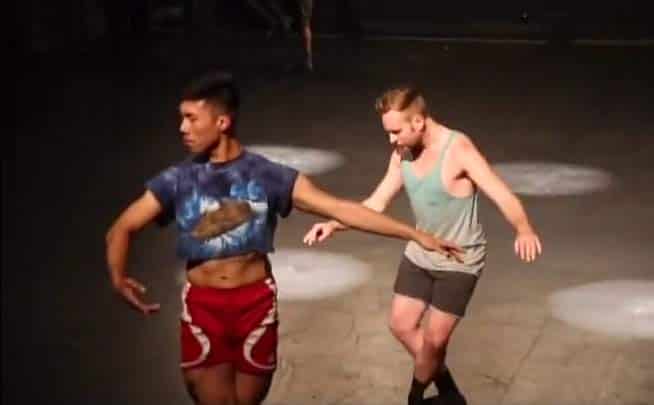
Radical ballet
2014
Photos

Reviews
A Difficult Dance: Radical Ballet and the Politics of Reception
Five guys. Playing games. What is going on in their minds? These production taglines for DNA Theatre’s newest radical ballet were the extent of the dramaturgical information available for the audience to process Red Light Green Light. In the weeks preceding the show, the dissemination campaign had been strategically restricted to those three phrases, creating a mysterious and anticipatory aura around the event. Even the house program notes were sparse, limited to credits and acknowledgements.
Showing up at the newly relocated Theatre Centre in Toronto very close to curtain call, I did not have the time to read through the hanging pieces of paper making up the lobby installation. Later, I learn that these consist of process notes for the work by DNA’s artistic director, Hillar Liitoja. Instead, I entered a perplexing scene in which a woman aggressively pointed to selected audience members waiting in the lobby while shouting “YOU! YOU! YOU!” before ushering them into the dimly lit performance space, one small group at a time.
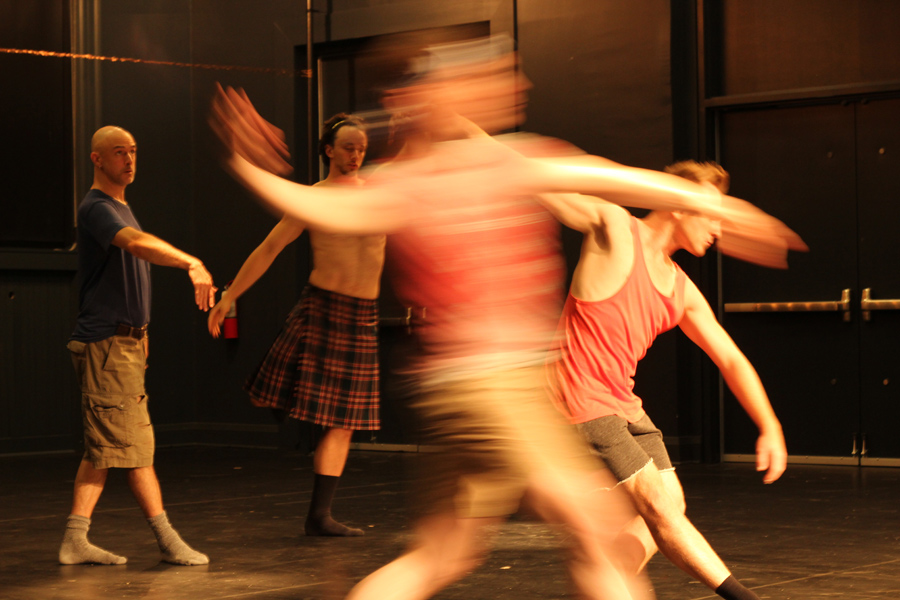
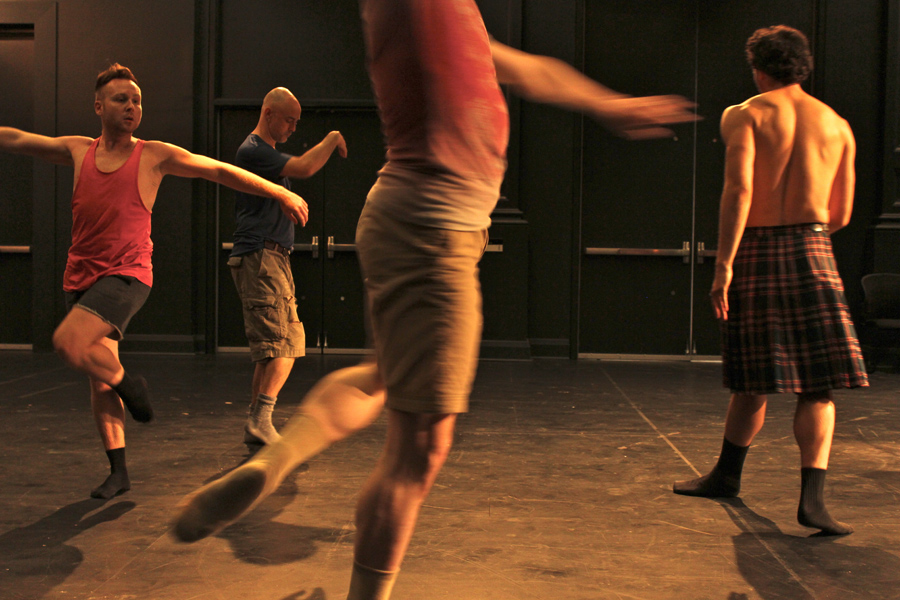
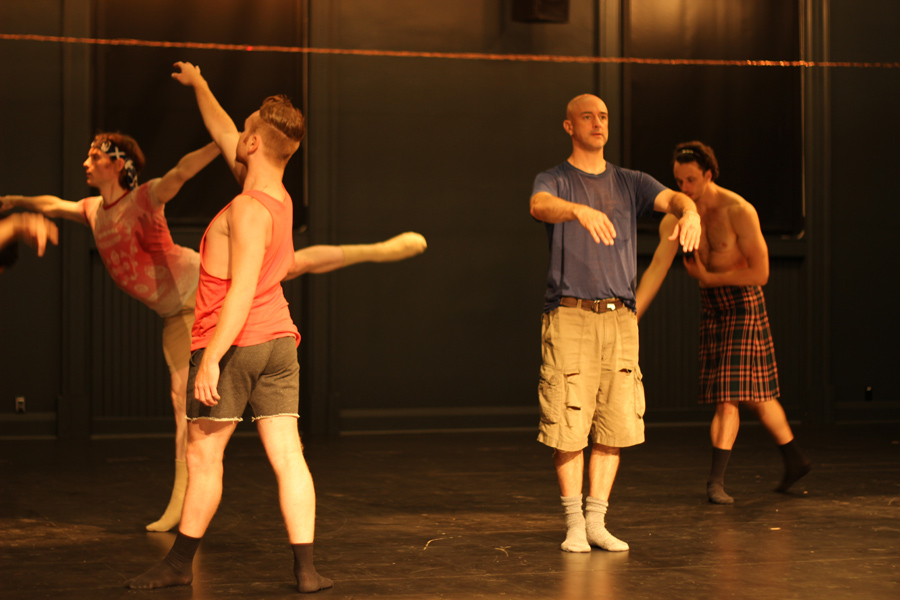
Walking in with the second-to-last of those groups, choice of the U-shaped configuration of seats was now limited and I choose a chair at floor level, stage left, facing into the action. From my vantage point, I take in a set table downstage, at which a man and a woman are seated across from the dance space, stoically observing five male performers – Justin da Luna, Ryan Lee, Kealan McLaughlin, Jeremy Nasmith, and Kevin Rees – in rehearsal clothes. The theatre walls are exposed and the set-up is clearly reminiscent of an audition. The tension is palpable; the energy, dark.
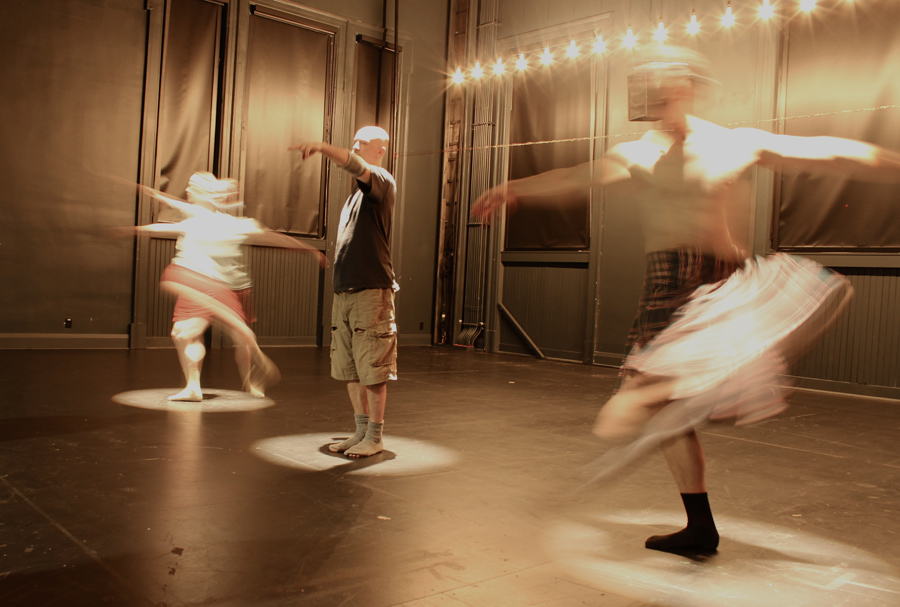
The dancers stagger and stand immobile in the centre of individual, crisp-edged pools of white light. The two seated at the table put on heavy-duty hearing protectors, their movement direct and economical, before the man, Liitoja himself, picks up a handgun and detachedly shoots upwards. The sound is deafening.
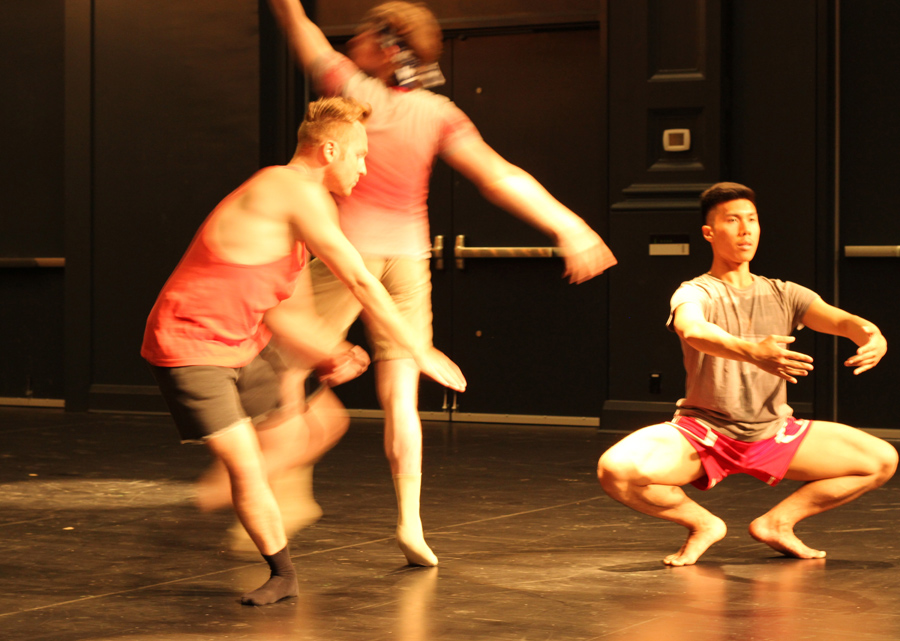
In contrast to the audience, the dancers are not startled, as if having been desensitized over time. Instead, the shot sets them into motion: they each perform their own ballet-derived phrase. Their paths through space are clearly defined; they may cross one another’s trajectory, but do not physically interact. Eventually, they return to the reappearing pools of light, hold still for a tension-filled, uncomfortable amount of time, and Liitoja shoots again. The dance phrases resume, on different paths this time, eventually returning to the pools of light. More stillness, another gunshot, another phrase, repeating the pattern twenty-four times in total, testing the audience’s endurance through litany.
Over the course of this clock-like cycle between blasts, the dancers display modulations in emotional tonality that are subtly expressed and do not appear to follow a narrative. Each of them proves to be a remarkably accomplished technician, using their physicality in rigorous ways. Although not all of the performers identify as ballet dancers primarily – for example, Ryan Lee hails from the contemporary genre – the movement is well-embodied by all parties. Each of their individual movement signatures is very clear and, as a result, each dancer is revealed in his distinctiveness; a departure from the ballet form’s usual preference for homogeneity.
As gunshot succeeds gunshot with metronome-like physical and emotional regularity and a detached precision, a noteworthy variation comes through Rebecca Picherack’s lighting. Twenty-four large bulbs hang upstage and, with each detonation, a new one lights up. By the end of the work, all of them are bright, not dimming or changing in any way when the five dancing men finally leave the space, apparently of their own volition. The bulbs remain at full brightness, the shooters, impassive. The game is seemingly over, yet the purposeful theatrical incongruities make the ending ambiguous and a tense silence hovers over the unsure audience. On the evening I attend, this lasts for a good two minutes before a fellow attendee musters the courage to initiate the clapping.
Do I enjoy my experience? Not particularly. I feel trapped: I am left to fill time with my own inner dialogue in an environment that inspires the worst of conversations. Does it send me home thinking? Most definitely. I think about radicalism and its definition – whether it can be self-proclaimed when it comes to creativity. Not debating the fact that it can certainly be applied when it comes to form, I also recognize that the notion of radical ballet is plausible. That being said, does radicalism automatically need to be identified with harshness and underlying aggressiveness, or is the violent edge simply an area of artistic interest in Liitoja’s case, running a parallel course?
Posted August 7, 2014
Red Light… just Red Light
Recall the children’s game, Red Light Green Light, where everyone creeps forward while IT has their back turned? DNA Theatre’s Hillar Liitoja does and has created a five man “radical ballet” around the concept of a game with strict rules.
As demonstrated in the lobby with stage management diagrams of movement, numbered in order, durations denoted with lighting indicated, Red Light Green Light is a series of 24 variations. Seemingly, each variation has been inspired by a concept, word or emotion, like flummoxed, serene, obsessed or secretive.
The five performers stand in five specific pools of light that never go out. This is home base. They sometimes change positions and they are permitted to dance away during a variation, but each of the men has to return as the variation concludes. Every variation commences with a live shot from a starter’s pistol, fired by a judge-like figure sitting at a table in front of the audience.
Rarely do the five performers make contact with each other. One variation involved lifts, another featured a character struggle to be noticed by the others. But typically, each did his own thing – whether it was the soaring jetés of Kealan McLaughlin or the controlled shuffling grid-like movements of Kevin Rees.
Rebecca Picherack’s lighting brilliantly configures the game. When the first six variations finish facing front, almost no extra lighting is added. When the next six variations conclude facing stage right, lighting from the right becomes part of the show. While a string of bare bulbs occasionally reminds the audience which variation has just finished, Picherack conceives of numerous ways to use those lights, from chases to dim glowing patterns.
The infrequent and arbitrary music chosen often appeared to cover up the changing of the pistol rounds and didn’t influence the onstage movement significantly.
The most problematic element of this energetic and exhaustingly well performed piece is that it feels like an exercise, an academic dance meant for the company alone. The audience remains invisible and shut out of the rules of the game that has been created by Liitoja. Instead of projecting what word influenced a variation or allowing the audience to watch a ticking clock for each vignette, the obscured rules and restrictions make the performances become distant and remote, irrelevant to the viewing experience of this athletic and competent but incomprehensible stylistic ballet.
posted on The Charlebois Post, Monday, July 21, 2014
Guestbooks
After every performance, the audience exits into a space where Guestbooks are laid out. Some write in them; some don’t. Some send emails which are then taped into the books.
- Wow! Totally wild. Like going to another plane of existence. Thanks for the trip. Radical ballet rocks! - (RB)
- Perfection - (Bob Wallace)
- A Salvador Dali painting coming alive with all its disconnects.
- I don’t know how I was supposed to feel. I couldn’t tell you if it was good or bad. But it made me feel things you aren’t supposed to define. That is art. It was a piece of art. Beautiful. Raw. Real. Chaotic. - (Jenny)
- Incredible manner of marking the time. Twenty-four lights? Beautiful seeing that progression, even if it wasn’t always transparent in the movements themselves. Independence and harmony, full of constant surprise. Wonderful. - (Naomi)
- My heart stopped beating (almost)… What a beautiful, moving, shocking performance. It was so gorgeous, so incredible, touching. All the men dancing, so delicate, so precise, with joy and pain. It was one of the most beautiful dance pieces I have seen in [my] life, so meaningful and so so deep. DNA made a wonderful creation! Thank you for the dance, for the music, the lights, the direction. This is life. - (Manuela Büchting)
- O Hillar, of course you always try my patience… But in a (very) good way. - (Kirsten Johnson)
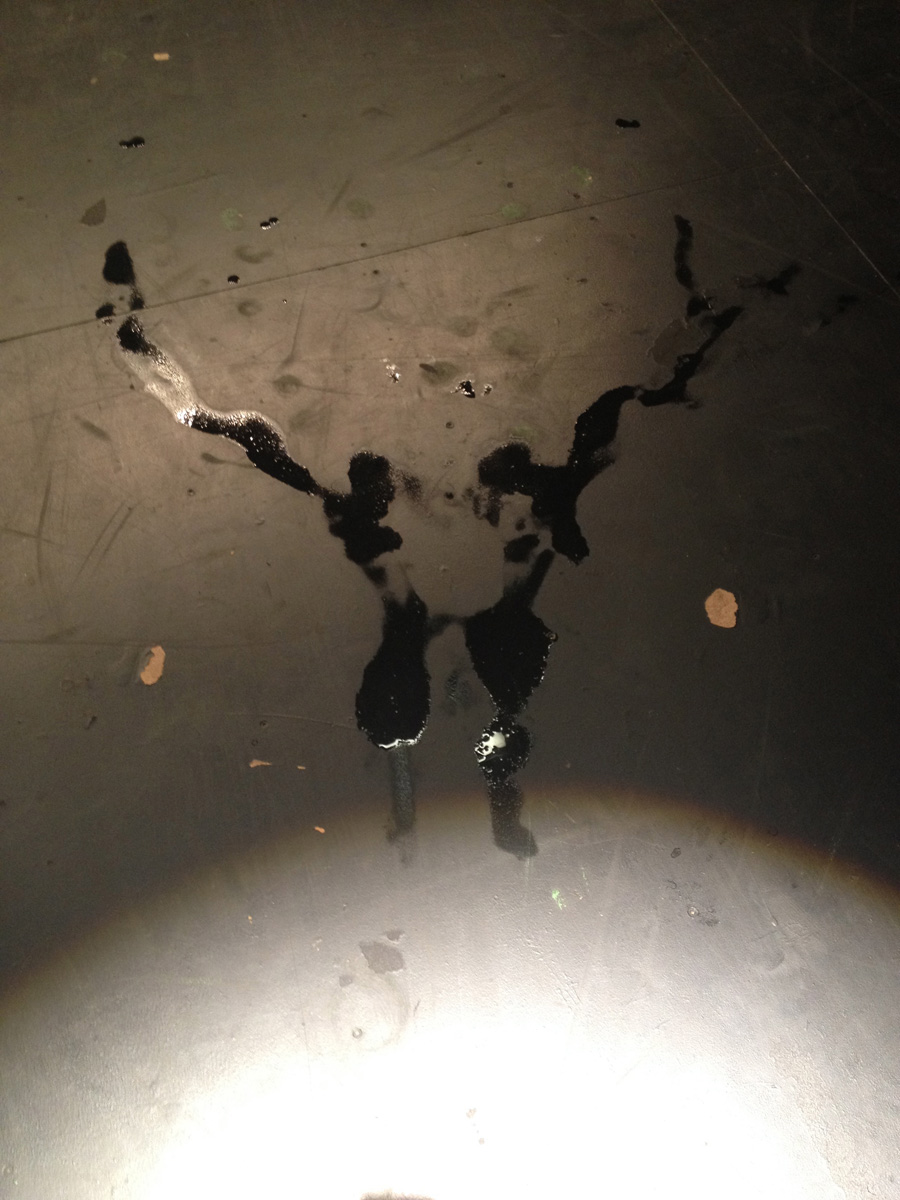
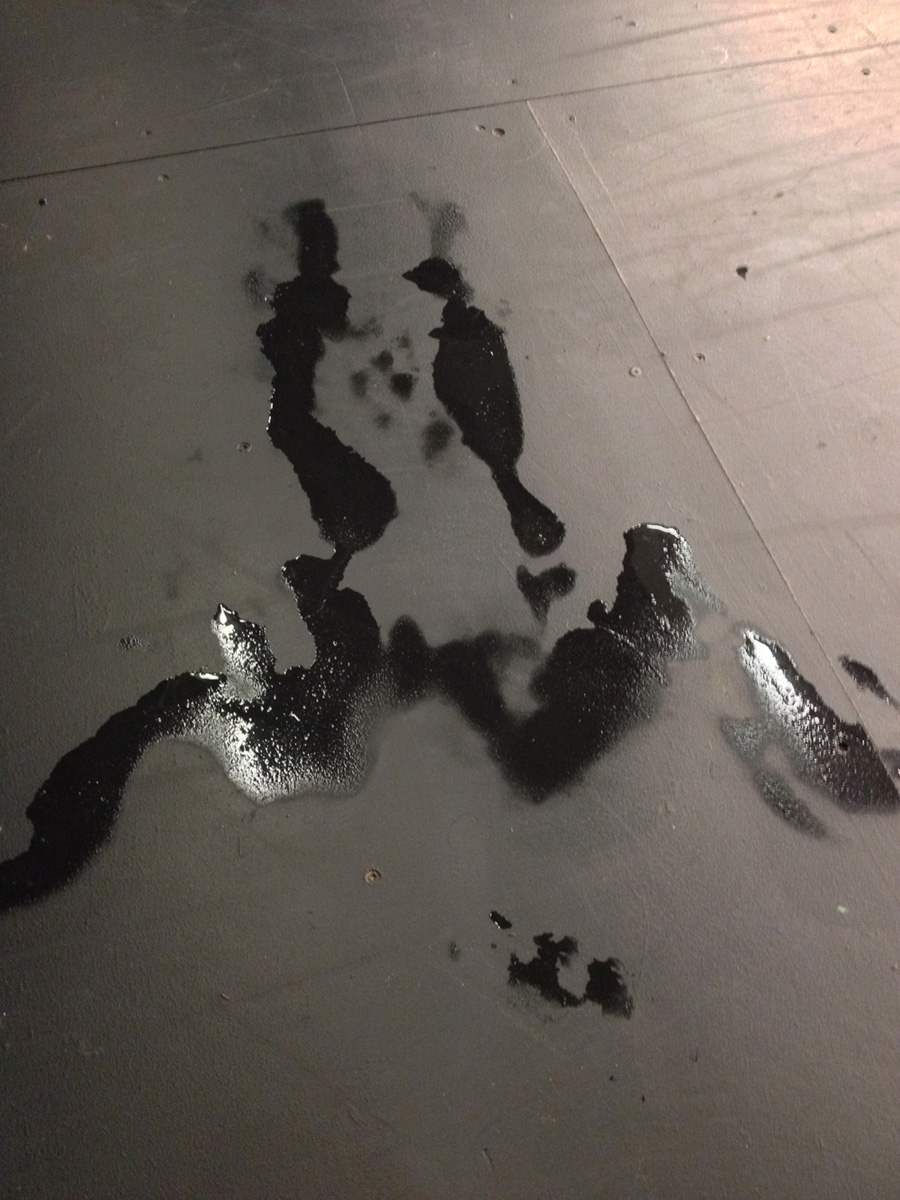
- The string of lights held so much for me… I don’t know what this show is about. … The athleticism! Felt strange compulsion to lay down in the pools of sweat left on the floor. Beautiful.
- Thank you for returning some of my humanity. - (Stephen Seabrook)
- Oh Hillar - since I cannot move anymore, I am so moved. What a beautiful piece. Cried several times, which was ‘skittish’? … Adored it. … And I HATE DANCE! - (Sky Gilbert)
- Your work was fantastic and really messed up… I enjoyed every moment of beauty, chaos, and stillness. You will be in my daydreams for weeks to come. I can’t articulate what I “learned” in any precise terms, but this was one of those moments/one of those movements that make me wonder… Thank you for a brilliant experience. - (Chiamaka Umeh)
- Loved it! I felt I’m watching my brain, and at the same time my brain is responding too! Weird! But awesome!!… Don’t know if anyone else has mentioned this or not, but most of the time when you guys went back under the lights in ‘neutral’ the shadows looked exactly like a womb/uterus. It’s creepily awesome. Thanks for the inspiration! - (Phoebe)
- Breathtaking. Beautiful. Heroic. Thank you. - (Jini Stolk)
- Hillar & Magda, thanks for this experience. I’ll remember the heart beating so violently through the bare-chested dancer, feeling threatened as a dancer came directly at me, the beauty of the magnificent jumps and ballet ‘moves’ these dancers were able to execute, puzzlement as to what was going on at times and an appreciation of how much work it takes to be a ballet dancer… Oh yeah, the sweat, I’ll remember the sweat! - (Kevin)