Details
Director: Hillar Liitoja
Cast: Sky Gilbert, Matthew Scott, Ken McDougall, Eleanor Yeoman, Ed Fielding, Rosalia Martini, Hillar Liitoja, Ensemble Cast
Venue:
The Palmerston Library,
560 Palmerston Avenue Toronto, ON
Production dates: November, 1990
Video
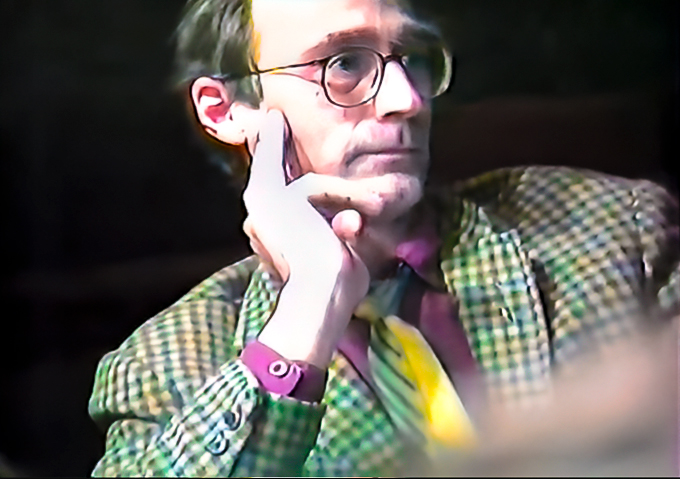
a devastation concerning AIDS
The Palmerston Library
1990
Reviews
The Panel, a Devastation Concerning AIDS
To get the full flavour of this show it would be necessary to see it several times. In his efforts to confront the audience and make its members think independently, Liitoja has not given enough through action or coherent text in certain sections to allow the first-time viewer a chance to really understand what is happening.
In an informally theatre-shaped setting the actors go through a series of sometimes synchronous actions and speeches. After an apparently disjointed opening the central action begins: a panel of seven characters sit around a table, assisted by a moderator and a judge. The rules of order are occasionally nonsensical. Members of the audience are asked to contribute to the discussion: a discussion about AIDS. At the back of the room a holistic healer concocts a brew in a blender throughout the entire play. (Holding up an ingredient, she intones its name: “beet”, while other action overlaps.) The audience, if it is brave, gets to taste the results in a Eucharistic gesture at the end of the show.
The play makes the point that we know little about AIDS. Formally its staging suggests the confusion, aggression and fear with which we face the subject. Audience members are compelled to sit unshielded by other bodies, to converse with actors, to look at erotic pictures; as we are forced to think about and deal with AIDS in our lives. Setting forth no single point of view as the correct one (although Sky Gilbert’s paean to the fallen heroes of the syndrome is more compelling than the comments of his fellow panelists), The Panel does mourn the tragedy of its ravages.
Theatrum #22, Feb/Mar 1991
The Panel
The Panel, the first part of DNA Theatre’s year-long AIDS project, offers the kind of controlled and repetitious pandemonium that’s a trademark of director Hillar Liitoja. Here, though, there’s more polish than in the past, a sense of organization in the apparently random world that incorporates text, performance and even audience seating.
The work’s centre is a panel discussion about various AIDS issues, involving 7 panelists, a moderator (the deadpan Matthew Scott), a looming and unpredictable judge (Liitoja) and audience response. Within a highly structured framework, alternate views are tossed back and forth, sometimes simultaneously. Meanwhile, in a corner, a holistic healer (Rosalia Martini) calls out the ingredients of a potion she’s mixing, and tells a choppy narrative.
The composite text (classical sources, newspaper clippings, medical comments on AIDS) and music (tango, Judy Garland, big-band sounds, 19th-century romanticism) is an intentional blur; the bulk of the evening comes across like a game show on heavy drugs. The juxtapositions are sometimes humorous and, surprisingly, they occasionally touch the emotions.
The show could be shorter and have the same effect, but The Panel has its own brand of attention-holding theatricality.
NOW Magazine, Nov 22-28, 1990
A Hybrid of Theatre and “Reality”
Hillar Liitoja has been silent since his exploded production of Hamlet two years ago. Now he has returned with something completely different, a play about AIDS that is a strange hybrid of theatre and public discussion group.
Someone wishing to see The Panel must descend the Palmerston Library spiral staircase that leads to the basement theatre. Halfway down the staircase a “ticket-taker” has been positioned, who is really a ticket-taker – you must pay him – but also an actor who will challenge you in unpredictable fashion. After I passed by, he collapsed on the floor in a death spasm and spoke his last words as I clambered down the staircase.
The theatre is more properly an environment, where you sit in one of a scatter of chairs around the room. There is an empty table in the middle where, it will later emerge, the “panelists” sit. At the moment there is little going on, except for a blond woman hanging from the ceiling at one side intoning Blake’s poem, The Tiger, into an echoing amplifier.
As always, whether for financial reasons or as part of his personal esthetic, Liitoja uses mainly amateur actors, though it must be understood that some of them are experienced and committed to Liitoja’s work. Others, the youngest ones, are used in such a way that their youthfulness becomes a poignant aspect of their performance. There are also several professionals, including Sky Gilbert and Eleanor Yeoman.
Matthew Scott plays the moderator of the panel, wearing a red bathrobe and explaining in a theatrically slow and projected voice the maddeningly bureaucratic procedure by which each person will be allowed to speak. The panelists are a strange congeries of types: Sky Gilbert plays an aggressive homosexual who wants to deny that the HIV virus causes AIDS; Yeoman, mystifyingly described in the program as a “devout Heliconian,” advocates a prissy and alarmed monogamy; Ed Fielding as an “invalid” in a wheelchair prophesies doom. A variety of other views come from a self-described “promiscuous” young woman who insists that her body awareness will save her from harm, an exiled Argentinian dancer (Ken McDougall) who preaches holistic medicine, and so on.
Each appears to be quasi-improvising his speeches, and each is ruthlessly cut off by the moderator using a bell or loud buzzer. He then performs a dancer’s pirouette and asks each panelist to summarize his views. A “judge”, played by Liitoja himself, sits at the back of the theatre on the floor and sometimes interrupts with pointed opinions that are, however, just as personal as those of the panelists.
The theatrical artifice (underlined by a continual drone of drug and plant remedy names from a woman at the back dressed as a lab technician, who is mixing these ingredients together) seems designed to show that human beings are vain, foolish and self-deceiving; nothing seems to be lost by having them cut off by the moderator in mid-sentence. But because their speeches are a strange mixture of written text and personal improvisation, we are left with the uneasy feeling that they – the real people playing these roles – are expressing opinions that they hold in “real life”.
The ambiguity becomes more painful when audience members are asked to question the panelists. Several do, and again one doesn’t know if they are actually members of the public or “plants”. As it turns out, several are simply audience members, and so their questions – and the panelists’ answers – about AIDS are pure “reality” and not part of a theatre event at all.
As often happens in Liitoja’s work, a seeming carelessness and casualness (Sky Gilbert yawing, other actor-panelists wandering over and sitting in the audience from time to time) are counterpointed with a controlled ritual. At the end, the moderator uncorks champagne and solemnly offers a glass to each panelist, while the “lab technician” – quietly friendly and informal – simultaneously offers each member of the public a sip of the brew she has been concocting.
In other hands than Liitoja’s this could all be pretentious and awkward. But he is an artist with a strong sensibility, especially in his ability to mix ritual action with the powerful use of music (another element that continues throughout the performance) and random sound.
The Panel is a smaller work than some of his others, and in many ways is less controlled and formalized. But even this lack of control seems to have been a decision taken with a view of the subject matter – who is to control AIDS? – and never the result of uncertainty or artistic confusion.
The Globe and Mail, November 23, 1990
Guestbooks
After every performance, the audience exits into a space where Guestbooks are laid out. Some write in them; some don’t. Some send emails which are then taped into the books.
- Oh my fucking God! I almost sort of couldn't deal with it! … I need a dark quiet room to get over it.
- That was really weird.
- Thank you for the impression and lit table of refuse. Despite the contrast of the opinions in [the] air AND because of their collision AIDS and FUN in one minute – Yes!
- Good intensity – tension of time between true personal opinions & assumed ones. More conflict than in Rhubarb! a couple [of] months ago. Discipline of rules, interesting forms – worth paying for this time.
- Sky [Gilbert] was terrific … some uneven performances – but as usual 1000% better than most of the trash that passes as Toronto “theatre”.
- (Mike Hoolboom) - This is an excellent play. I think the schools suck shit!!! when it comes to this topic.
- I have never experienced more reality on any topic in my life.
- This play was very strange indeed but enjoyable because of the audience participation. It made me feel more part of the play itself.
- This play was definitely different but excellent. And my opinion is that the schools are just trying to scare you from having sex, but it's not working.
- The silence was particularly effective. Tasty music selections. Ace on the whole.
- I believe that it changed my mind on the subject. We as individuals don't talk about sex, aids or death at any close distance. Your play is vulnerable because it tries to go closer on these issues than I wold have dared. In short, it's an intelligent, human and provoking play.
- Well, some objections I think!
- This show is good to see more than one time. I also feel like committing violence. Mentioning it here lessens the repression.
- (Matthew Brown) - Every night I have been more excruciatingly bored with the pace of the moderating-man. Jeez. Yes but quite an essential balance before nose-dive into blur of personal, statistical, sociological, etc.
- (Flannery Fielding) - It's working. I was struck by the texture & spontaneity.
- Fun and dangerous interaction!
- The moderator is an asshole!
- Excellent idea, but too much anger may cloud your message. Also – the panelists' views seemed very much one-sided – [why not] provoke thought in those who already think they're right – are you talking too much to the “already converted”? PS Very intriguing, interesting, annoying, provocative theatre.
- The American conspiracy theory is far too important to be overlooked.
- Very successful non-conformist theatre.
- I was feeling every possible emotion in the span of an hour. Thank you. I love to laugh. You gave me laughter.
- (Nigel) - Immaculate 'infection'!