Details
Director: Hillar Liitoja
Cast: Veronika Hurnik, James Thomson, James O'Reilly, Randall Lanthier
Venue: Six Stages,
109 Niagara St. Toronto, ON
Production dates: February 1
to February 25, 2001
Video
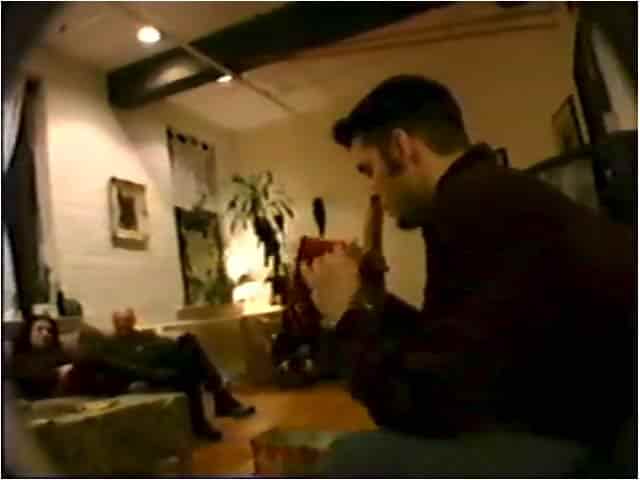
2001
Photos
Reviews
Play Portrays Killers But Doesn't Exploit
The miniature international festival known as Six Stages starts superlatively with a new work from DNA Theatre, headed by the much–feted but long-absent author and director, Hillar Liitoja.
Paula and Karl is a home-grown piece on a home-grown subject: Remove the final vowel from one name and add it to the other, and you will recognize the source.
Putting Paul Bernardo and Karla Homolka on stage is not something I would have thought either possible or desirable. I would have been wrong. Frivolous though it may sound, the change of names adds the right amount of distance, gives the piece its own identity and helps remove any hint of exploitation. Mr. Liitoja takes us inside his character's heads. More crucially and completely, he takes us inside their world.
I mean that literally. The production revives an old form of environmental theatre that has fallen into disuse and that I never much liked in the first place, Here, though, it justifies itself.
The play is staged in a private house. We are greeted brusquely at the door, told to line up against the wall and escorted downstairs. What awaits us is a spacious basement living room with a kitchen in the corner. We are told we may stand, sit or wander as we like, even look into the adjoining rooms, but must get out of the way if the actors require it.
As one of the last to arrive, I found it difficult to decide which of those already to decide which of those already present were actors; some I recognized as colleagues but others seemed remarkably relaxed and at home.
A video was playing, The Cider House Rules; I got quite caught up in it, since for a long time nothing else happened. Gradually it became clear the young blond woman slumped on the couch half-watching the movie, half-reading a book, and awesomely reposed was the only actor present; presumably she was Paula. Eventually a man joined her: her husband, Karl, home from work or somewhere.
As they greet one another, we in the audience switch automatically into different mode; we start to judge the performances. At first they seem like what might pass in a normal theatre for good naturalistic acting; at these close quarters they appear artificial, the voices preternaturally clear, the sentences too precisely formed.
But as they go on talking, as Paula prepares Karl a sandwich and he eats it, as he proudly produces a large newly bought dildo and they play with it, as they begin casually alluding to somebody female kept bound and gagged in another room; as all this happens, the style begins imposing itself and the relationship becomes real, complete and frighteningly easy.
Veronika Hurnik's Paula, in particular, is more than just believable. It is the most completely, impregnably lived and inhabited performance I have ever seen; as closely detailed as the best screen acting but happening right there in front of us, unshielded and unedited.
During the action two detectives arrive, question the pair and ask Karl to show them around the house. We could have gone with them but it seemed more rewarding to sit and watch Paula as expressions of terror chased one another over her face.
Her role is perhaps the more rewarding, because it is the more varied of the two. Karl is pure unreachable bully: obviously capable of anything, though perhaps the most terrifying thing he does on stage is to crank up the volume of his CD player when Paula tries arguing with him.
James Thomson, having found the right implacable register for him, has to stay with it, but Ms. Hurnik is able to play both victim and manipulator, and to do strange things to our sympathies. When the police leave, having found nothing, she still knows the game is up and pleads with Karl to end it now; we know her motives have nothing to do with compassion and everything to do with self-preservation, but we want to believe differently and to side with her. One reason for respecting the play is that, at its close, it finds the right way of stopping us.
James O'Reilly and Randall Lanthier as the investigators are in a different level, giving good, even humorous, cop-show performances.
The play has been tightly and superbly edited; some loose ends simply add to the conviction. The real victim, of course, we never see, hear or even learn much about; the play would be intolerable, in every sense, if we did.
Despite its initial, and probably excessive, intimidation tactics, the production avoids the kind of superior stance that has traditionally accompanied this kind of presentation; it doesn't punish the audience for being there. It does what the theatre is supposed to do: show us humanity, which must include its phases of inhumanity.
National Post, Feb 3, 2001
Paula And Karl
DNA Theatre founder Hillar Liitoja is both a genius and an asshole, but I suspect not as much of either as he'd like his audiences to believe.
His latest offering, Paula and Karl, is staged in an apartment on Niagara St., the fictional home of a married pair of serial killers. On arrival, the audience is escorted up in a freight elevator by surly stagehands who bark that you can sit wherever you want, provided you must be prepared at all times to move out of the way of the actors.
But over two and a half hours, staged in real time, very little happens. For the first 20 minutes, for instance, Paula (Veronika Hurnik) plays with her hair, reads People magazine and watches a video. Then her husband, Karl (James Thomson), comes home. They talk. She makes him a sandwich. He eats it. They discuss the tortures they plan to inflict on the young girl they have tied up and stowed somewhere in the apartment. They are briefly visited by a pair of police detectives (James O'Reilly and Randall Lanthier). They fight. Karl slumps in a chair and listens to jazz. They fight some more.
Meanwhile, the small audience sits, alternately confused, disturbed and bored, beside Paula on the couch, or next to Karl at the dining-room table, or even adventuring, as one man did during lulls in the action, to open the fridge and examine its contents, check out CDs and leaf through a magazine.
Plays like this are usually much better in theory than in practice, and such is the case with Paula and Karl. More bullying than provocative, in the hands of lesser actors, it would be an utter failure. But the excellent cast, in particular Hurnik and Thomson, meticulously directed by Liitoja, have incredible focus.
The problem is the script: a trite meditation on the banality of evil (and an unnecessary allusion to Paul Bernardo and Karla Homolka) that, unforgivably, neither illuminates the souls of the serial killers nor creates any sympathy for their victims.
EYE Magazine, Feb 15, 2001
Not Right at Home with Paula and Karl
A production that drops the audience in the middle of a domestic incident plays out
like an exercise in theatrical sadism
Six Stages, a minifestival of innovative international theare, got started Thursday with a highly unusual show. Arrive at 109 Niagara St. by 7 p.m., follow the signs around the back of this old warehouse across the street from the meat-packing plant, and step up to the loading dock to get your instructions. You're here to see Paula and Karl, some play about a young couple that takes place right in the middle of their apartment. You're told you may move anywhere you want, sit anywhere you like, but be prepared to give up your seat without notice. You may not interrupt the action, but you may leave whenever you wish.
Up you go in the freight elevator, enter the apartment and find Paula (Veronika Hurnik) watching TV while styling her hair. There's nothing much for you and about 20 other spectators to do except find a more or less comfortable spot to sit and watch her – or her video, which features some historical drama. Maybe the whole evening's going to be like this, an excruciating experiment in reality theatre, courtesy of experimental director Hillar Liitoja and his DNA company.
Then Karl (James Thomson) arrives home and a domestic drama begins. He's threatening and autocratic; she's subservient and nervous. Gradually, they reveal the grotesque secret of their marriage and you're stuck spending two more hours with them, bounding off the couch each time they decide to sit down – unless you are going to be a coward and walk out on them.
Technically, this show is performed with impressive skill: under Liitoja's controlled direction, Hurnik and Thomson never once acknowledge the spectators or even appear to see them. This ability to keep "focus" is considered basic competency up on a spotlit stage at the front of a darkened auditorium; in these circumstances, it's a greater achievement.
Beyond that, however, the performances are stilted. Thomson exudes an almost cartoonish menace; Hurnik alternates between flat impassivity and some bug-eyed face-twisting that is supposed to indicate her character is afraid. In some mouths, the pedestrian script that Liitoja has written might possibly achieve a kind of ghastly naturalism; here it is mainly bland and occasionally ludicrous. Although they never slip out of character, one is all too often aware the actors are acting, which detracts from the claustrophobia this project seeks to achieve.
The show takes place in real time. There are some dramatic developments in the apartment, but you also watch and wait as Paula makes a sandwich and as Karl eats it; you spend minutes listening to jazz as Karl sits slumped in a chair. Conventional theatre creates the illusion of reality with tightly scripted speech and action which edit out the gaps and inanity that is characteristic of much of life. From that troupe of Australian clowns who have tried living for days in department store windows to Quebec director Robert Lepage's attempts at languourous realism, experimental theatre has often tried dropping the illusion to play out action with the true slowness of life. It's a technique that, used sparingly, can sometimes create magnificent tension, great poignancy or even outrageous comedy. Here it should be building sheer horror, but often Paula and Karl is boring.
Of course, the theory behind this show is much more worthy of review than the practice, but on that higher plane Paula and Karl also seems lacking. In the program (which is only available at the end of the show), DNA lists its goals, which include creating unique experiences and using unique venues, two things it certainly achieves here. Another stated goal is to "create performances that are deeply affecting."
It's not hard to affect an audience – keep prodding the spectators and they are sure to start squirming.
Although I have often suspected that Liitoja is a theatrical sadist who takes pleasure controlling his audiences, making people uncomfortable can be a perfectly legitimate artistic pursuit. It can be a good way to make them feel – or more likely – to think, about both form and content. And there this show is a disappointment: Despite the great risks it takes in confronting an audience, it has very little to say about couples like Paula and Karl. Beyond that, anything it achieves is purely subjective: Whether its unusual parameters teach you something about yourself and your ability to withstand this experiment will depend on you.
I left 109 Niagara without having learned anything I did not already know about sadism, about theatre, about myself: I was affected, but to little purpose.
The Globe and Mail, Feb 3, 2001
DNA Theatre Stretches the Envelope Again
Paula and Karl, a new play written and directed by DNA Theatre founder Hillar Liitoja, is a portrait of a sexual psychopath and his female accomplice revolving around the themes of use or abuse of power, and of free will, coercion and complicity. Remove the final vowel from one name and add it to the other, and the inspiration for this new work is evident.
The horrific and ghastly, never mind cruel actions of Paul Bernardo and Karla Homolka were odius and vile. Like many repugnant things, evil has a way of captivating mass attention. Public opinion here is hardly polarized. The vast majority of people were and are dumbfounded by the extent of the couple's depravity. The behind the scenes machinations orchestrated by the duo to receive lighter sentences have offended many. As well, the rights of the families of the victims have been trampled over. Not only did they lose their daughters, but through legal legerdemain their right to privavy has been violated time and time again.
In view of the above, it would take considerable courage to stage a production, even loosely based, on Paul and Karla. Liitoja has never been a shrinking violet; indeed, it sometimes seems that he takes an almost perverse pleasure in making audiences squirm with discomfort when faced with the unexpected. Over the years DNA's trademark has been strongly linked to creating an unusual audience environment. Upon entry into the performance area one is requested to make room for the actors if necessary; otherwise freedom to move is given. The question for the member of the public often is who is the audience, and who is in the cast?
Liitoja and DNA received accolades for the production This is what Happens in Orangeville, also based upon a violent crime that deeply affected a community and garnered wide-spread attention.
With Paula and Karl then, DNA is not treading on new ground. As can be expected, variables in audience reaction to such a production range from one extreme to another. The same can be said for reviewers. Robert Cushman of the "National Post" lauded Liitoja for superb editing, and commended the fact that the playwright focused on the sexual psychopath and his accomplice rather than the nameless victim. Cushman opined that the play would have been intolerable, in every sense, if the audience had learned about the victim.
The intended nature of the performance as stated was to create a mood of uncomfortable voyeurism and discomfort. Cushman felt that the intimidation tactics were perhaps excessive, but concluded that the production avoided any stance of superiority, a trap that is easy to fall into. For the reviewer, Paula and Karl did what theatre is supposed to do: show the audience humanity, which must include its phase of inhumanity.
Reviewer Rachel Giese of alternative newspaper "Eye" disagreed, finding that plays such as this are usually much better in theory than in practice. Giese commended the excellent cast (James Thomson as Karl, Veronika Hurnik as Paula, and James O' Reilly and Randall Lanthier as police detectives) for delivering the playwright's intentions. The acting was more bullying than provocative, and in the hands of lesser actors would have been an utter failure. The focus of the cast is emphasized, as well as the meticulous direction of Liitoja. Environmental design – space, lighting and sound – are by Steve Lucas and Steve GordonMarsh, dramaturgical support by John Delacourt.
Yet Geise found flaws with the script, considering it a trite meditation on the banality of evil that fails to illuminate the souls of the serial killers, and also fails to create sympathy for their victims. Giese finds that during the two-and-a-half hour production very little happens.
Others certainly disagree. It is precisely this devilishly dichotomous approach that Liitoja and DNA have honed to a keen point. Love it or hate it, DNA's work is not your run of the mill Mirvish production.
Paula and Karl was selected as the headline event at the Six Stages Festival. It runs until February 25th, Tuesday to Sunday at 109 Niagara Street (King and Bathurst area). Performances commence at 7:00 P.M. sharp. Further information by telephone (416) 504-7529.
MEIE ELU (OUR LIFE), Feb 21, 2001
Guestbooks
After every performance, the audience exits into a space where Guestbooks are laid out. Some write in them; some don't. Some send emails which are then taped into the books.
- Thank you all for a unique experience. It's so nice to go to the theatre and be stimulated. Yes, it does seem rather like an evening with Karla and Paul I MEAN Paula and Karl. ...I also loved the dildo on the TV … and the creepy detectives … All were great [but] I never want to ever be in this apartment again.
- (Sky Gilbert) - Controlling male – victimized female? Not convinced … Generally, a very benign, relaxed, comfortable evening.
- It is very good to have an appropriate amount of time to digest all the big themes and small details, which were all beautifully in place
- (Heather Lash). - Like nothing I've ever seen. Brave … Theatre meets reality TV.
- Challenging for the mind and difficult for the spirit.
- Although my experience with you work is limited … my immediate reaction is total awe and being floored over your insistence on challenging the audience and seriously demonstrating that rules are for those content to achieve mediocrity.
- (Sean Ward) - Remarkable intensity, hell compacted. Monster as victim / victim as monster. An eerie security in being a voyeur surrounded by danger. Bold. Courageous.
- (Patrick Conner) - I'm still in a daze – I have no idea what I just saw but I'm sure it will be with me for awhile.
- 2 things, among many, that impress and engage me – 1) how the audience becomes an organism with actors in a complex choreography of shifting places, sitting, standing to accommodate each other. 2) how "trademark" DNA techniques are incorporated into a "naturalistic" style: eg. When Karl uses the music to harass Paula by raising and lowering volume repeatedly. Many of the moments hit home – like the tense long stare / silence between the two actors / characters. Fascinating.
- Hillar: hard to do, hard to stomach. Congratulations. Like all DNA shows, it will alter my own personal DNA – aesthetic / political / sexual ...
- Oh my God. … I feel like this is so much closer. But just a little more … and it will be something – no, not something, it will be like the nightmare this story was born in, something like the nightmare (working) I've had with these two on subway platforms reading about them, in the studio when I closed my eyes, and let their photos burn into a negative in my brain. What a beautiful, hellish gift.
- (John Delacourt) [dramaturge] - Impressive play. Also interesting: the audience as witnesses embroiled into the scene. Also exciting: how performers' movements and audience's movements had to merge.
- I feel upset. I feel like crying. Wonder about my boyfriend.
- Demand and command voyeurism. An exceptional exposition of divisive subordinate relationships.
- (Evan) - Thanx for helping to get me and my friends into a Valentine's day state of mind.
- (M. D. Martin) - Just moving around the set elements adds to the feeling of discomfort. … Veronika – you convey so much with so little (effect, not effort) … A great antidote to the impassivity of mass media.
- (Craig Thompson) - Very well done – intense and real. Of course, the threat of being run over at any moment heightened the experience. Bravo!
- The psychological territory of this piece which is "dangerous" in my mind … reactions which are frightening to me. In particular, how attractive certain elements of these people's lives appear to be … their everyday lives are satiated with an extraordinary intensity … and that they are treading into the forbidden – going further and further into dangerous territory all the time – I'm jealous of this.
- (Nina Arsenault) - Hillar, another highly disturbing but memorable show.
- Never has a bottle of Champagne felt so evil. Woe.
- (Gwen Bartleman) - Great great job. Very upsetting. Very well written. Beautifully executed. I loved all the little details.
- (Sigrid Johnson) - You knocked me off my perch – as always. Great work all.
- (Jini Stolk) - Gosh yar pushin' it, buddy … (again) – It's gotta be the most radical piece you've ever done. (I've got to say something about tedium as an art from, I'm just not sure what. Nonetheless these seem clichéd notions and that was no cliché.)
- (Ed Fielding) - Wow. Possibly, no, definitely the most intrusive theatre I've seen in a long time.
- (Debra Felstead) - Makes you question how far your fantasies could be pushed where reality becomes boring and fantasy enters into the "real" world. Very provocative. The pauses in "action" or the moments of less action added to true realism and heightened the tension. Bravo for pulling it off.
- (Meredith Caplan) - The warmth of the room … It is a suffocating claustrophobic experience – with freedom to roam.
- Really fitting the audience into the 4 walls of theatre is brave and a magnificent idea.
- (Gabriele R.) - The play was brilliantly staged in the warmth of a beautiful home which made the horror more palpable. … I will recommend it to the serial killer fans I know.
- (Kalli Paakspuu) - Entering into the private world – psyche was original and somewhat cinematic – shifting perspectives almost camera-like. Tense, terse, believable dialogue.
- New and thrilling. I thought the concept was amazing.
- (Zeph W.) - I feel rubbed raw.
- (David Duclos) - I was sitting beside Paula on the couch when she was attacked. I've never felt as torn about not stopping someone from inflicting pain. I won't forget that moment.
- (Atom Egoyan) - When it was over, I was left with a huge weight in my chest.
- (Simla Civelek) - This is an important work – it's shown the darkest, harrowing depths of psychic despair emerge from the utterly banal.
- True publicprivacy is difficult – why was the speaking sounding wooden, stilted and self-conscious? If these two were truly alone in their apartment? (Mathew Jergusson)
- Very interesting, entertaining and exciting.
- (Rebecca) - I think I need "post traumatic" stress therapy. In a couple of places I wanted to leave.
- (Liia Remmelkoor) - Congratulations on a brilliantly brutal piece. … I loved the silences, the quiet awful moments where nothing happened and I couldn't help thinking about her tied up. I loved / hated the ropes – they hurt. I loved the little touches around the room. I loved watching the audience react, play games, laugh, show off, wonder what they could or should do. And it was brilliantly horrible to be left in the room at the end of the show with her still here. That hurt most of all.
- (Ian Carpenter) - Nice play, Shakespeare!
- I wanted to take a knife from the kitchen and stab Karl repeatedly, and Paula, well I just wanted to slap some sense into her: amazing, how I could feel this considering that I felt somewhat perverse, just watching. … Nice twist at the end to see Paula not as much the victim as we thought. Oh, what games psychotic people play. A dark, profound and moving piece.
- (Asunta) - Thank you for the reminder of our inhumanity to one another. Veronika … you are one of the most courageous and gifted actresses I have ever watched.
- (Kenneth) - Well, it was shocking! The ropes on the curtains were ingenious.
- (Kari) - DNA: makes me scream. Sleep. Laugh. Wait. Smile. Yawn. Experience. Wonder. Cringe. Re-think. Breathe. Anticipate. Sick. Stare. Dream. Fidget. Chew. Accept. Love, hate and … thanks for the effort, thought, risk, talent, humour, horror … The first DNA (in an extremely long time) that I just watched and not worked on … so quite a shock (again, for the first time). I will remember
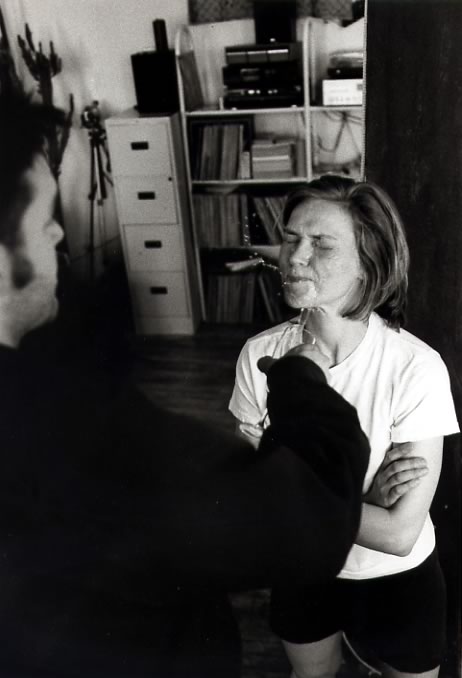
- (Chad Dembski) - Definitely an interesting experience – like nothing I've seen before! Got a little splashed during the Champagne-throwing part, but I forgive you (if you forgive me for eating your chocolate-bars props).
- The use of space was intriguing – a game of musical chairs for the audience members … BUT, the lack of consideration for the audience was unnerving … even still, I still felt like the actors were "performing" … I didn't believe that the actors' portrayals of the characters was convincing … Good effort!
- I thought it would with a whimper, not a bang – but you're right, Hillar, silence is best. Good slice of life razor-thin.
- (Mare Tiido) - You've made me realize boredom can be a theatrical tool when skillfully applied. I mean this a compliment. Banality of evil – too right!
- (Stephen Caulfield) - I wish the play had been 9 hours long. I didn't want it to stop. I also wish I could have eaten one of the chocolate bars. I loved being a ghost. Something I've always wanted to be.
- (Virginia Paakspuu) - Fun to visit your place. You two are weird. What are all these other people doing here?
- (Jack Walker) - There are many dares offered to the audience … The door to the bedroom is left open and we're dared to save the girl. It's a dare too, or maybe a challenge, to not let the audience be released at the end with applause at the appearance of the performers to tell us all "It's all right, I understand it, but we don't want it." We are given nothing; it's a reversal. Normally theatre is a gift: it's something shared. This, though, it's something taken from us. A thing I'll need to continue to consider.
- (Michael M.) - Thank you for taking risks and doing great theatre. Stunning, knocked the wind out of me – intensity and spontaneity. Chilling. Beautiful. Fierce.
- Very intense. I found myself surprisingly cool even at the most jolting moments. I attribute this to the calming effect of the actors, who who were impressively comfortable in their roles. I only paced like a scared cat at the quiet moments.
- Thoroughly nauseating in all – good job,
- (A.F.) - Done with skill, discretion + probability.
- Exceptionally intriguing and exceptionally boring.
- I felt I was inside this piece. So much time to reflect while the action was happening. The musical scene was horrifically beautiful and funny?! Terrifying – the lack of any moral conscience. So real – comic timing – painful pauses. I hate to love it. I feel sad. Yuck.
- (Jenn Boggs)