Details
Director/Choreographer: Hillar Liitoja
Cast: Andrew Scorer, Kirsten Johnson, Sky Gilbert, Ed Fielding, Shirley Josephs, Ensemble Cast
Venue:
The Theatre Centre, 191 Lippincott St. Toronto, ON
Production dates:
January, 1989
Photos
Reviews
Hamlet
When DNA Theatre mounted a production of Hamlet in Toronto last winter, a spectacular collision was anticipated between the experimental company’s buzzsaw theatrical style and the monolithic Shakespearian text.
DNA practices what might be called cubist theater, taking sealed-up narratives and slicing and dicing them into indigestible flows of experiential data that undermine unified and absolute interpretation. DNA productions are typically chaotic and challenging, subordinating narrative focus and individual feats of acting to multilayered sequences of meticulously orchestrated tableaux.
Hamlet (with a backwards “e”) was similarly structured. Hillar Liitoja, who writes and directs all of DNA’s work, conjured up innumerable distancing fragmentation devices during the non-stop 7-½ hour production, in which audience members were allowed to wander wherever they chose throughout the multitiered wraparound set.
Hamlet began outside the theater building. Audience members were led to a backstage door, then questioned by two guards before being allowed to enter. Inside, 23 performers had already begun enacting highly stylized, seemingly unconnected fragments of text.
The fragments were repeated continuously for about an hour, then suddenly converged into the second scene of the text.
From the point on, Hamlet unfolded more or less according to the original order of Shakespearian scenes, through most were greatly lengthened. Spliced among the Shakespearian scenes were numerous added ones, ranging from the absurd - a deadpan musical romp called The Teacup Dance performed by the itinerant players - to the expressionistic - various performers assembled into a sort of Greek tragedy chorus machine that echoed Shakespearian characters. Some added scenes played off the text, others served to disrupt it, still others bore no apparent connection.
With as many as seven scenes going on simultaneously, and with the Shakespearian ones greatly underplayed as if to resist attention, audience members had to frame their own courses of events as they chose which scenes to follow. Also, the performance was self-reflective insofar as some performers interacted with audience members and the stage crew.
Such theatrical strategies seemed to indicate a Brechtian rebellion against canonical narrative in which meaning is foreclosed and passively consumed, but a reversal occurred. The Shakespearian text (perhaps because it’s so deeply embedded in the Western literary unconscious) retained its weight and was strangely reified. As audience members crept up close to watch Hamlet quietly berate Ophelia in a remote corner of the set, for example, or Claudius whisper plots to Polonius over dinner, the text as a whole was elliptically brought to life. Upturned through it was, the production ultimately succumbed to Shakespeare and ratified orthodox theater.
If the reversal was deliberate, then Liitoja was toying with the audience by showing how far he could bend in the fourth theatrical wall without breaking it. That the reversal was probably accidental and beyond the director’s control is indicated by what seemed to be a final act of frustration against an inability to break free of the text: after Hamlet’s death in the final scene, Liitoja killed off Horatio, Osric and almost everyone else that Shakespeare left alive.
Ultimately, it is impossible to say what Liitoja meant to do with the production because it was vague in some places and excessively cryptic in others. Through Hamlet showed some of DNA’s anarchic exuberance, in the end, the collision that was anticipated turned out to be an awkward embrace.
Hamlet
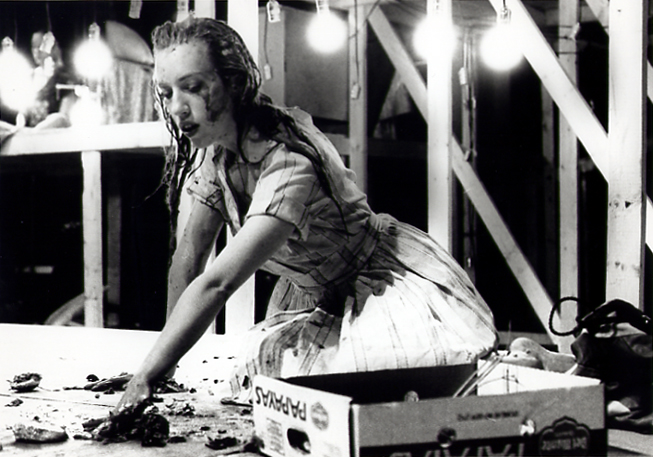
This 7.5 hour extravaganza began by plucking its audience members one by one from the lobby, confronting us in a back alley with sentinels, and flinging us into a manic environment peopled by fragments of Shakespeare, as well as such beings as: a Mistress of the Underworld, who sentenced each newly-dead character to twenty minutes of silence; a sword-swinging Japanese samurai; a notary who honked and whistled whenever a line of text met with her approval, duly writing it down; a stunning intense Ophelia (Kirsten Johnson) who demonstrated her madness by squashing fruit and vegetables against her body; a hilarious Polonius (Ed Fielding) who stretched pedantry to a breaking point with his amazingly slowed-down speeches; a tape of the director’s rehearsal advice broadcast on loud speakers; a chorus line of teacup dancers; and many other wonderfully imaginative things too numerous to remember.
At the centre of all of this was some very clear and clever Hamlet, especially a bald-headed Andrew Scorer as the brooding prince - a truly amazing spectacle, considering its obscenely small budget. Where it failed, in places, was by leaving too much time and space between events and images, granting us freedom to move around, but sometimes providing precious little to explore (this may have been partly a product of seeing it on a poorly-attended day since, as with all of Liitoja’s work, the audience becomes part of the show), leaving me wishing it had been more tightly layered and compressed in time.
Theatrum, April/May 1989
Hamlet
excerpted from an article by Mark Czarnecki which also reviewed The Wooster Group
A collaborator with The Wooster Group has been Richard Foreman, who in a recent interview called it “the one group in New York as interested in getting in trouble as I am.” As an admirer of Foreman who acknowledges his influence, DNA’s artistic director Hillar Liitoja clearly shares that interest. Trained as a classical pianist, he abandoned that career when he discovered Ezra Pound’s poetry, whose fragmented, imagist style has contributed to DNA’s unique theatrical language.
Touted as a “nine-hour Hamlet” – it’s really only seven and a half – this environmental production is daring, entertaining and surprisingly polished considering its large cast and minimal budget. The set fills the entire Theatre Centre, and the audience walks around and through it as the action swirls around them. Freedom of movement is necessary in such a long production, and also provides a kaleidoscopic perspective that mirrors the sharp excisions and repetitions in Liitoja’s idiosyncratic text.
Hamlet is Shakespeare’s longest play, but Liitoja’s basic premise is it’s actually too short. By dedicating a full day to it, he gives his vision, his actors and his audience a chance to stop worrying about jolts per minute and to restructure time. Liitoja has focused on five or six seminal scenes: several involve Ophelia (the graveyard scene takes half an hour without the gravediggers); and another repeats five times a 100-line section in which Hamlet mocks Rosencrantz and Guildenstern.
On the other hand, “To be or not to be” is addressed to Horatio so softly and privately that barely anyone hears it.
What Liitoja has added is just as important as what’s left – or left out. Above all there’s the music, a compelling and often deafening melange drawn mainly from arch-romantics Bruckner and Sibelius which underlines the intense emotion saturating Liitoja’s interpretation. This Hamlet is really a symphonic score, with visual and aural motifs elaborating on basic themes (food, lust, secrets, betrayal) stated and restated throughout.
Typical is a female samurai who at the start performs a precise sword dance, and returns halfway through to cook a fish. Apparently random, her presence nevertheless creates a measured counterpoint to the frenzy of the main action.
The performances, many exaggerated almost to caricature, are stunning: Sky Gilbert as Claudius is a treat in boots and leathers, Kirsten Johnson’s Ophelia redefines stage madness and Andrew Scorer makes up in physical presence and subtlety what his Hamlet lacks in words. For anyone passionate about theatre’s power to explore possibilities and expand consciousness, DNA’s Hamlet is not to be missed.
Metropolis, Jan 26, 1989
The Occasion Was the Thing
Hamlet has just skewered Claudius through his studded black leather jacket.
Suddenly a voice rings out through the theatre, saying something like, “Bravo! He deserved it. But you should have done it earlier.”
The voice is that of Hamlet’s dad, the old king. For most of the play, he has been lounging around in the underworld, a balcony high above the action, presided over by a bosomy, florid madam.
After someone is slain, they are greeted by the madam who tells them that they now belong totally to her, and sentences them to 20 minutes of silence. Meanwhile their staring portraits are hung on a wall.
Since we’re now at the final scene of the play, this celestial (or hellish) equivalent of the actors’ green room is pretty crowded. Rosecrantz and Guildenstern are there. So is Ophelia, now dressed in everyday clothes and smoking a cigarette.
All that remains is for Horatio to drink a vial of poison and die, reciting “To be or not to be” – in French. Plus the big clean-up of bodies and more portrait-hanging.
Poor Bill Shakespeare. What a pity he didn’t have the imagination to dream up all this.
But Hillar Liitoja and his often outrageous DNA Theatre did. It may be said, without fear of contradiction, that their production of Hamlet, now at 191 Lippincott St., is not exactly a conventional production of Shakespeare’s classic.
It’s spread out over seven-and-a-half hours (trimmed from the planned nine). This is a Hamlet experience, long on stylized movement, repetition, music and technology, short on text and interpretation. And a lot of it is very boring.
It’s as if someone had taken a sledgehammer to a Ming vase and then tried to glue it back together, discarding the many pieces that don’t fit and substituting others. The resounding unanswered question is why?
Let’s flash back seven hours. We’ve been milling around in the theatre lobby for a while when suddenly a stern man comes in. “You, you, you and you,” he barks. And you follow, meekly, around the back of the theatre – “keep up at the back, there” – and up an iron fire escape. Two guards fire hostile questions at you (roughly based on Act 1, Scene 1), and you are pushed, none too gently, into a darkened theatre.
Strings of naked lightbulbs flash and then dim. Music is pumped through the theatre at deafening levels. A young woman repeatedly bellows a warning: Do not interfere with the actors ... Do as we say or leave.”
Another woman, dressed in red, is perched by a Sears benchsaw. She rings a bell and points occasionally.
Two guys dressed in red dressing gowns tell you (politely) where you can and can’t sit and give bits of advice.
You find a seat, take off your coat and stare around. There’s Claudius pacing up and down. And that one must be Horatio. And that guy with the shaven head and red sleeveless shirt, is he Hamlet?
It’s not long before you realize that there’s no point in sitting in one spot. So you wander up a level; whoops, that must be Claudius (Sky Gilbert) and Gertrude (Shirley Josephs) climbing into bed together. You hurry on upwards, to the underworld. “Only the dead can enter here,” you are told firmly.
So you’ve had a chat with a couple of old acquaintances and explored the environment. Claudius, meanwhile, has got out of bed, dressed and eaten most of a whole chicken.
An hour slips by before Act 1, Scene 2 starts, the first extended passage of text.
The acting, frankly, is not good. The words are delivered with stultifying slowness. Polonius (Ed Fielding) speaks with such leaden, hollow lugubriousness you could swear he has fallen asleep mid-sentence. Rosencrantz and Guildenstern stutter and scuff the floor bashfully.
The players arrive like bizarrely dressed teenagers going to a prom. They strut their stuff before Andrew Scorer’s Hamlet by doing a little dance to 1940s swing music, clattering teacups and saucers.
There are no set intermissions but you can wander in and out, take a break, returning to the smell of yet more chicken and a fish being grilled.
The play meanders on. A guide wanders over. “I think you’d better clear this area to be absolutely safe,” he says. Moments later Hamlet goes violently mad.
Then it’s Ophelia’s turn. She squishes vegetables over herself and the floor and munches carrot after carrot.
The audience? Well, we’re still wandering around, catching up on gossip and getting to know absolute strangers.
Ophelia’s funeral seems to take forever. There’s a slow march in, headed by someone carrying a small ghetto blaster. The priest drones on and on in Latin.
We’re all getting punch-drunk, even a little giggly. Then it’s all over. Coats abandoned hours ago are grabbed and it’s off into the night.
And do you know, I actually enjoyed myself. The occasion, rather than the play, was the thing.
Toronto Star, January 23, 1989
Seven-and-a-half-hour Hamlet “Mutation” Sells Shakespeare Short
There is no question that Hillar Liitoja is talented. Also that he is exasperating, self-indulgent to the point of bullet-headedness and, not infrequently, exquisitely boring.
So, if you are told that he has staged a seven-and-a-half-hour version of Hamlet at the Theatre Centre on Lippincott Street, you will be prepared for all of the above, won’t you? As for the matter of the length, that requires explanation.
Into this “genetic mutation” of Hamlet, Liitoja’s company has interjected a vast amount of performance art. To give just one example, the bearing on of Ophelia’s body – normally about 10 seconds’ business – takes a good 15 minutes. Since it is one of the more beautiful sequences in the show, it is worth describing further to give an idea of Liitoja’s approach to the stage.
The body is borne by four courtiers, all female, dressed in contemporary, pressed black pants and white blouses, like upmarket hotel doormen. It is on a canvas stretcher. Ahead of the pallbearers a fifth person solemnly carries a small portable tape deck, almost invisible in the darkness, save for the mysterious red dot of the “on” light. It is playing a balletic marche funebre that I couldn’t identify: just a snippet of the piece, a haunting melody about a minute long, endlessly repeated on the tape loop.
With each repetition, the pallbearers repeated a simple choreographed movement: stop, take a single step to the left, raise the free arm to the forehead in a slow military salute (except that the hand finishes up in front of one’s eyes rather than against the forehead), step back to the right, proceed forward several steps; stop and repeat as the melody begins again.
Somehow the visual image of these young women executing a military salute in respect to the death of another young woman, but varying the hand position to suggest covering the eyes against weeping, all of it executed with extreme formality, adds up in that mysterious way expressionist theatre works, to create a deeply moving image. The 15 or so minutes of this entrance pass in a moment.
The show, on which Liitoja has worked for a long time, uses various techniques. By contrast with the formality just described, there is the fencing scene, which is staged almost languidly and casually. That is, Claudius and Gertrude leisurely sit at table while Hamlet and Laertes clumsily sort through swords, try them out, dawdle and think. When the match begins, there are several rests during which their faces are wiped.
Gertrude drinks the poisoned wine almost casually; Claudius’s attempt to restrain her is sotto voce, as though he were afraid to be overheard. She collapses quietly forward onto the table. When Osric some moments later notices her, his outrcy goes unheard. The fencing continues. Everything seems to take forever; as indeed it does, in real life.
The result is that “tragic” emotions seep away. The viewers find themselves tittering during the lengthy pauses. Because of our freedom to move around the playing area, people skulk about to get a better view, now of Laertes’ corpse, now of Hamlet. The paradoxical effect of this anti-illusionism is to involve the viewer more deeply.
Having underlined several of the show’s strengths, I must go on to explain why I feel it is a failure; or at least, that it is not anywhere near complete.
First, there is Liitoja’s habit of working with a mixture of professional and amateur actors. Nineteen of the 23 performers are amateur. An extremely controlling director such as Liitoja – he literally wanders through the performance, urging his actors on, sometimes speaking sharply to members of the audience if he feels they’re in the wrong place or looking in the wrong direction – needs a corps of malleable actors.
In his case they are usually very young, with limited skill in voice and movement, and clearly doing exactly what they are told. One youth spends nearly an hour pacing slowly on a balcony: a “guard” at Elsinore castle, presumably. Six young women at another point make a neat line facing the audience and shriek at the top of their lungs on cue. And so on.
It is one thing to use such actors in your own script; it is another to ask them to speak Shakespeare. Whenever they try to do so, the meticulously crafted illusion immediately tears.
The principal actors also are deficient. Sky Gilbert plays Claudius as a leather queen, which is possible but entirely gratuitous. He also speaks blank verse in dull and bombastic fashion. The marvellously craggy-looking Ed Fielding plays Polonius, but takes the character’s slowness of speech too far, dragging the words out to the point of distraction. Shirley Josephs’ Gertrude has poise and speaks passably well, but is far from Stratford quality.
Ironically, the most interesting work comes from one of the amateurs. Kirsten Johnson’s Ophelia is technically deficient – she doesn’t begin to deal with speaking the verse – but she has an affecting transparency of emotion and has evidently thought a great deal about what kind of girl Ophelia might be. This Ophelia gets tongue-tied; she fades away in mid-sentence, terrified of the patriarchal males around her. Her anger emerges in the peculiar uncomfortable way she holds her body.
Here the natural talent of the actor works well with Liitoja’s imagination. In the madness scene, the “flowers” she hands out are, in fact, fruits and vegetables, which she hurls at her tormentors, and squashes obscenely on her chest. It is a remarkable scene.
Andrew Scorer’s Hamlet is often effective because the bald and athletic Scorer, with those glinting hooded eyes, is a charismatic personality. He is also capable of awesome sustained energy, and occasional finely nuanced suggestiveness.
Just as often, however, he is a bull in a china shop. And often his most famous soliloquies are delivered in a mutter while others speak over top of him. This serves Liitoja’s ideas about deconstructing the text, but doesn’t make Hamlet’s job any easier.
Thematically, Liitoja seems to be exploring the authoritarianism of Claudius’ court. There is more than a hint throughout of a sado-masochistic sexuality. But the show is far too loosely and sloppily staged to admit much discussion of Liitoja’s intentions. At the moment, neither his purposes nor Shakespeare’s are well served.
The Globe and Mail, January 23, 1989
Guestbooks
After every performance, the audience exits into a space where Guestbooks are laid out. Some write in them; some don’t. Some send emails which are then taped into the books.
- Goes beyond surrealism, expressionism or any other kind of 'ism' and stuff like that … It borders on total insanity and madness, occasionally going over. Not too long, believe it or not – stunning and too weird for words, unlimited, strange, big, and so on.
- I've worked, I've played & I've died for DNA, but I've never been so alive. Seeing is believing & the belief was outrageous. Wonderful.
- Now. Once again life is on course for me. I believe I am a more relaxed person after this. A lot has changed. Thank you.
- (Gerard Leckey) - Is this Hamlet? … This is Hamlet! Only DNA brings out my most anxious feelings. Wonderful.
- (Asunta) - When one reads Hamlet, one dreams about what it could be, how far it could go. I know that for about the next five years, I won't be able to dream about Hamlet. Because this Hamlet overfills my dreams of Hamlet. And, in five years from now, when I will be able to dream again about Hamlet, those dreams will be deeper, going further in the understanding of human life. L'art est un témoignage. Vous m'êtes précieux.
- (Paul Lefebre) - Smashing as always.
- Bravo! An extraordinary feat!
- (Diane Weinrib) - Truth, beauty, monstrosity, pain, envy – imperfection in perfection.
- (Deborah) - You may have no idea how important this night was to me … I hope you DO have an idea … but if you don't … IT WAS!! I stuck out the whole thing; I laughed … and I really did cry … Thank you very much!!
- OUCH!
- This is the way to experience Shakespeare!
- Marvellous!!! They should bring the schoolkids here instead of Stratford!
- Affengeil!!
- The only company in Toronto I'd break a gut to see. Congratulations!
- (Bob Wallace)