Details
Director/Choreographer: Hillar Liitoja
Cast: Andrew Scorer, Kirsten Johnson, Sky Gilbert, Ed Fielding, Shirley Josephs, Scott Maudsley, Patricia Nolin, Akascha Kerekes, Adrian Foster, Daniel McIvor, Ensemble Cast
Venue:
Festival de Théâtre des Amériques, Espace Libre, 1945 rue Fullum, Montréal, QC
Production dates:
May, 1989
Photos
Reviews
You Can't Make a Hamlet Without Breaking Eggs
Our host is a funny fellow. A kind of smiling provocateur inhabited by a baroque imagination.
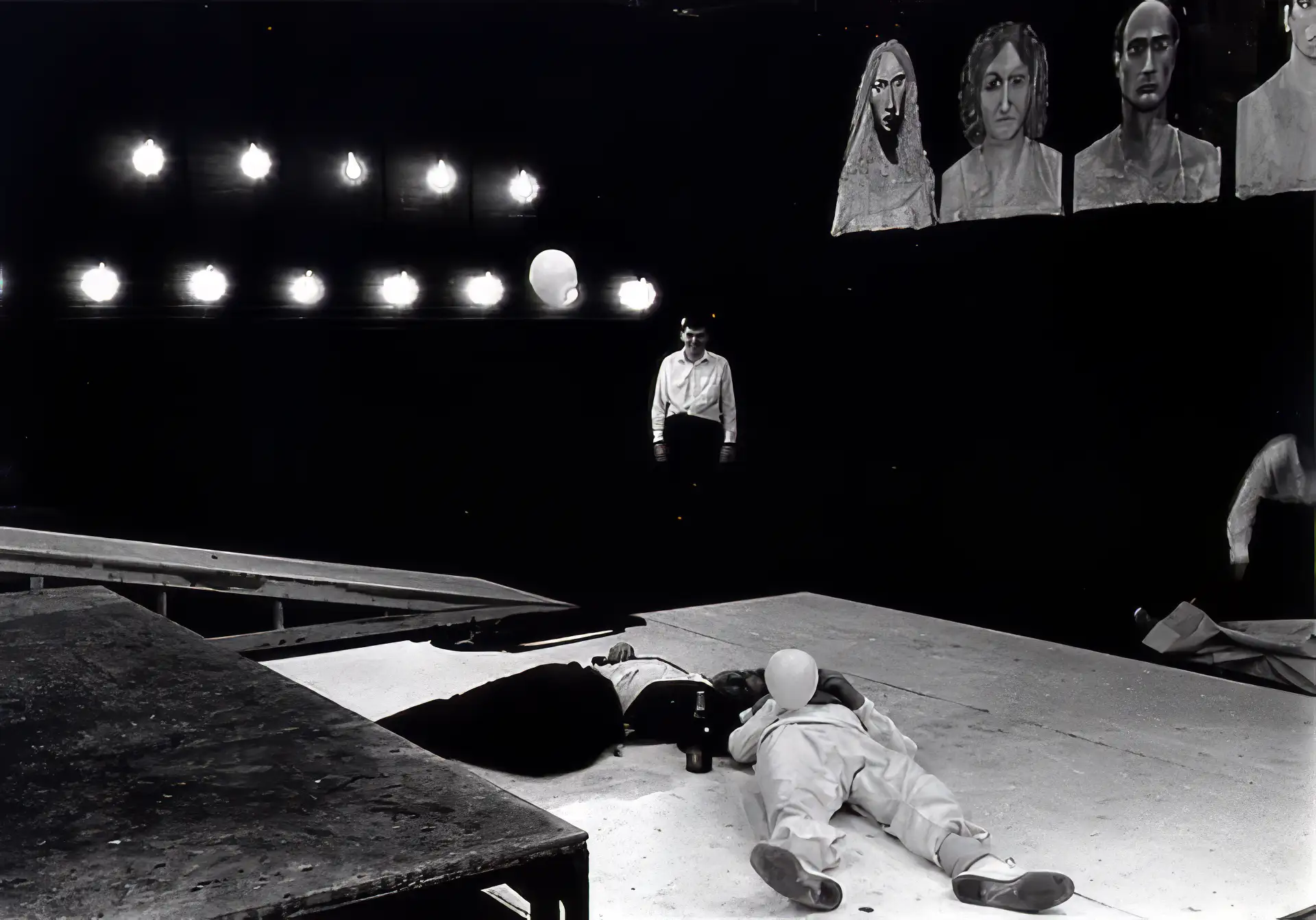
In this instance, the play begins on the street, the Fullum, within sight of the Parthenais prison. Twenty minutes of waiting in my case. Two imperturbable specters pass by on the sidewalk... You're ushered in in groups of three or four, to soften you up. Other ghostly doormen greet us, like lepers in a fancy restaurant. They harangue us, then push us into Elsinore Castle toward our miserable fate. Inside, Bruckner's music is deafeningly loud. Actors and spectators get in each other's way in this five-story castle, overlooked by a paradise run by a scantily clad ferrywoman of souls. The Grand Guignol is bizarre: specters faint, the servant Osric tries in vain to present the queen with a macrame cape, Hamlet discourses on drugs, a close sword fight is captured in a snapshot, and so on.
But in the end, the count is the same: nine corpses, just like in the real play, the same plot: Hamlet learns from the Ghost of the murder of his father, the king, and the remarriage of his mother to the murderer, Claudius, the king's brother. He swears to avenge him and, to deflect suspicion, he feigns madness...
A mix of genres
As one might guess, Liitoja mixes genres with gusto in his show. First, tragedy quickly gives way to farce or parody. He uses anachronisms in clothing and accessories, borrows from music hall and dance, cultivates ceremony, and applies a constant touch of orientalism, suggesting that The Dragon Trilogy has had an influence...
Music, or more precisely, the soundscape, plays a crucial role. The actors' voices often remain inaudible, drowned out by the avalanche of decibels. The idea? Undoubtedly to illustrate the characters' pathetic helplessness in the turmoil of tragedy.
Without breaking eggs?
You'll forgive me this cliché, but you can't make a Hamlet without breaking eggs, and Hillar Liitoja breaks them in abundance. He compromises himself, and he should be praised for it.
The problem is that, with his tendency to exasperate through the use of ultra slow motion and repetitions ad nauseam, he ends up getting on our nerves a bit...
One question arises: even dedicated to the myth of Hamlet, Shakespeare's most frequently performed play, does an 8.5-hour performance truly have the choice to "be or not be"? Given that the show is already difficult to observe with its profusion of scenes, multiple simultaneous scenes, whispers, and overlapping musical themes... it seems to me that Liitoja could have fully expressed his ideas and achieved a better result by concluding at midnight.
Certainly, his proposal deviates from the usual data of the spectacle and ultimately falls under the category of "happening" and performance, but to ask people for such a "lengthy" act of faith, it is not necessary to make them question their habits as spectators, it is necessary to give them a theatre that charms the senses, which does not exclude a measured provocation of the heart and the reason.
Let's face it, the show tightens up, becomes denser in the last three hours. As if Liitoja felt the need to condense it. This new approach begins more or less with a very beautiful theatrical moment: Hamlet and his mother, in a suggestion of the "skull scene," eviscerate and fry a sea bream, speaking to it solemnly, like Ophelia raving in a fruit and vegetable mash of her own making.
Also original is the idea of the passport to paradise that each protagonist must collect from the stage manager after death. And the final scene of self-criticism from paradise.
In conclusion, an ambitious and complex production that would benefit from a little more aesthetics and needs to be reduced to a less grueling length.
Le Soleil, May 31, 1989
On Ne Fait Pas d’Hamlet Sans Casser des Oeufs
Notre hôte est un drôle de pistolet. Une espèce de provocateur souriant habité par une imagination baroque.
Dans le cas présent, son théâtre commence dans la rue, la Fullum, à vue de la prison Parthenais. Vingt minutes de pied de grue dans mon cas. Deux spectres imperturbables passent sur le trottoir ... On vous fait entrer par groupes de trois ou quatre, pour vous attendrir la couenne. D’autres spectres portiers nous accueillent, comme des lépreux dans un restaurant chic. Ils nous haranguent, puis nous poussent dans le château d’Elseneur vers notre minable destinée. En-dedans, la musique de Bruckner fait un boucan infernal. Acteurs et spectateurs se gênent mutuellement dans ce château sur cinq paliers, surplombé par un paradis tenu pas une passeuse d’âme court vêtue. Insolite grandguignolesque: des spectres s’évanouissent, le serviteur Osric tente en vain de fair cadeau d’une capeline de macramé à la reine, Hamlet discourt sur la drogue, on tranche à la photo instantannée un assaut de sabre serré, etc.
Mais au bout, le compte y est: neuf cadavres comme dans la vrai pièce, même intrigue: Hamlet apprend du Spectre le meurtre de son père, le roi, et le remariage de sa mère à l’assassin, Claudius, le frère du roi. Il jure de le venger et pour détourner les suspicions, il feint la folie...
Mélange des genres
On le devine, Liitoja mélange les genres à qui mieux mieux dans son spectacle. D’abord, la tragédie y passe vite à la farce ou à la parodie. Il use d’anachronismes dans le vêtement et les accessoires, emprunte au music-hall et à la danse, cultive la cérémonie et applique une touche continuelle d’orientalisme, ce qui donne à penser que La Trilogie des Dragons est passéepar là...
La musique, plus exactement, l‘environnement sonore, joue un rôle primordial. Les voix des acteurs restent souvent inaudibles, écrasées qu’elles sont par l’avalanche des décibels. L’idée? Sans doute illustrer l’impuissance pathétique des personnages das la tourmente de la tragédie.
Sans casser des oeufs?
On me pardonnera cette farce cliché, mais on ne fait pas d’Hamlet sans casser des oeufs et des oeufs, Hillar Liitoja en casse à profusion. Il se compromet, il doit être loué pour cela.
L’ennui, c’est qu’avec sa propension à exaspérer pas l’usage de l’ultra ralenti et les répétitions ad nauseam, il finit par nous casser un peu les pieds...
Une question s’impose: même dédié au mythe d’Hamlet, la plus jouée des pièces de Shakespeare, un exercice de 8 h 30 a-t-il le choix d’"être ou ne pas être"? Déjà que le spectacle n’est pas facile d’obsevation avec sa profusion de scènes, multiples simultanées, de chuchotements, de chevauchements de thèmes musicaux ... Il me semble que Liitoja aurait pu déballer tout ce qu’il avait à dire et atteindre à un meilleur résultat en concluant pour minuit.
Certes, sa proposition déroge aux données usuelles du spectacle et relève en définitive du "happening" et de la performance, mais pour demander aux gens un acte de foi aussi "longuet", il ne faut pas que les faires s’interroger sur leurs habitudes de spectateurs, il faut leur donner un théâtre qui charme les sens, ce qui n’exclut pas une provocation dosée du coeur et de la raison.
Avouons-le, le spectacle se resserre, se densifie sur les ... trois dernières heures. Comme si Liitoja avait senti le besoin de se résumer. Cette veine neuve dans le traitement commence plus ou moins sur un très beau moment théâtral: Hamlet et sa mère poussent les hauts cris comme une jeune célébrante japonaise, dans une suggestion de "la scène du crâne", éviscère et met à frire une dorade, en lui parlant avec solennité, et comme Ophélie délire dans une pâtée de fruits et légumes de sa fabrication.
Originale aussi l’idée du passeport pour le paradis que chaque protagoniste doit aller quérir chez la régisseure, une fois mort. Et de la scène finale d’autocritique, depuis le paradis.
Pour conclure, une production ambitieuse et complexe qui tolérerait une peu plus d’esthétisme et réclame d’être ramenée à une durée moins éprouvante.
Le Soleil, 31 mai, 1989
A Disemboweled Hamlet
What can be said about this stripped-down Hamlet? Served with a stretched-out sauce? I confess my boredom with such a theatrical dish that smells of reheated leftovers from the 60s.
Hillar Liitoja offers nothing less to the festival-goers of the Festival de théâtre des Amériques (FTA) than a "maniacal object", a Hamlet freed from its bones, falsely exploded, where the apparent anarchy is regulated to the quarter turn in a navel-gazing enterprise whose goal is to acquire an audience that one pretends to disorient.
Patrice Chéreau, who has just signed a Hamlet, said that "there is a Hamlet for each era, and each Hamlet ultimately tells us more about that era than about itself."
The era, according to Liitoja, seems quite mercenary. I see in this undertaking to dumb down, repeat, and stretch out this play nothing but pure whim. From a play already so complex and so rich that all generations find themselves struggling with it, Hillar Liitoja shamelessly offers a needlessly bombastic, gluttonous spectacle (it lasts eight hours), clinging to old habits that, 20 years ago, demanded the assassination of the bourgeois principle of performance.
The problem with this false audacity of Liitoja — it is not because a Hamlet lasts eight hours that one is inspired! It is even the opposite — is that, in this rambling, one does not feel at all that there is, underground, in sensitivity, a theatricality that is at work.
Fine, the performance can be questioned or even disrupted, but in theatre, without justification, necessity, urgency, and the skill that is theatricality—the frank acknowledgment of its purpose—one can never claim to create meaning. Liitoja's Hamlet, beyond its superficial audacity, is meaningless.
The entire production is nothing but a series of cheap, inverted tactics. First, you're made to wait half an hour on the sidewalk because they only admit four spectators at a time. In an anteroom, you're stared at harshly, then shoved into the auditorium with the door slammed shut. Once inside, you're free to wander wherever you like in the dim light. Actors here and there rehearse gestures and lines, but nothing happens. It takes a good hour and fifteen minutes before any action even begins, and even then, it never really does.
I confess I didn't have the desire to continue following this circus for more than four hours (including a break for food). Such an approach quickly becomes repetitive, and if some, who embrace the concept thinking they're experiencing theatre as if they were discovering it from the inside, followed the charade until 2:30 in the morning, more power to them!
The lack of theatricality in this mock anarchy could have turned me off theatre forever. Instead, leaving around 10 p.m., I chose to be dazzled by the Korean fireworks exploding over Montreal. I switched festivals with a feeling of liberation, of joy...
I left Hamlet (admittedly the most fascinating character in the history of theatre) to his posturing, I left Hillar Liitoja to his little game of bourgeois iconoclasm.
Sensing my distress, the actress Patricia Nolin advised me around 8:30 p.m. to wander around the space, through the installation: "You'll find a sense of your own freedom," she whispered in my ear. As I walked, I found such a strong sense of freedom that I mustered the courage to tell myself that it was all boring, that it was all performed by actors roboticized by a dictatorial and stupid staging, and I left! The sounds of the pyrotechnic explosions were soothing to my ears...
Le Devoir, June 1, 1989
Un Hamlet Désossé
Que dire de cet Hamlet désossé? Servi avec une sauce étirée? J’avoue mon ennui devant un tel plat théâtral qui sent le réchauffé des années 60.
Hillar Liitoja propose rien de moins, aux festivaliers du Festival de théâtre des Amériques (FTA), qu’un « objet maniaque », un Hamlet libéré de ses os, faussement éclaté, où l’anarchie apparente est réglée au quart de tour dans une entreprise nombriliste dont le but est de s’acquérir un public que l’on fait semblant de désorienter.
Patrice Chéreau, qui vient de signer un Hamlet, disait qu’ « il y a un Hamlet pour chaque époque, et chaque Hamlet nous en dit finalement plus long sur cette époque que sur lui-même ».
L’époque selon Liitoja semble bien vénale. Je ne vois dans cette entreprise de décerveler, répéter, étirer cette pièce, que pur caprice. D’une pièce déjà si complexe et si riche que toutes les générations s’y cognent le nez, Hillar Liitoja propose sans vergogne un spectacle inutilement ampoulé, boulimique (ça dure huit heures), accroché à de vieilles manies qui voulaient, il y a 20 ans, que l’on assassine le principe bourgeois de la représentation.
Le problème avec cette fausse audance de Liitoja — ce n’est pas parce qu’un Hamlet dure huit heures qu’on est inspiré! C’est même le contraire — c’est que, dans ce charriage, on ne sent nullement qu’il y a, en souterrain, en sensibilité, une théâtralité qui s’exerce.
Va pour la représentation remise en question, ou chamboulée, mais au théâtre, s’il n’y a pas une justification, une nécessité, une urgence et une habileté qui est la théâtralité, l’aveu franc de son projet, on ne pourra jamais prétendre faire du sens. Le Hamlet de Liitoja, au-delà de son audace superficielle, n’a pas de sens.
Toute l’entreprise n’est faite que de tics racoleurs à l’inverse. D’abord, on vous fait poireauter une demi-heure sur le trottoir, parce qu’on n’admet que quatre spectateurs à la fois. Dans une anti-chambre, on vous dévisage durement, on vous pousse dans la salle en faisant claquer la porte. Une fois entré, vous êtes libres d’aller où vous vouler, dans la pénombre. Des acteurs, ici et là, répètent des gestes, des répliques, rien ne se passe. Il faudra une bonne heure et quart avant qu’un début d’action démarre sans vraiment démarrer.
Je vous avoue ne pas avoir eu le goût de continuer à suivre ce cirque plus de quatre heures (comprenant une sortie pour bouffer). On fait vite le tour d’une telle approche, et si certains, qui adhèrent à la proposition en pensant vivre le théâtre comme s’ils le découvraient de l’intérieur, ont suivi le manège jusqu’à 2h 30 du matin, grand bien leur fasse!
L’absence de théâtralité dans cette fausse anarchie aurait pu me dégouter à jamais du théâtre. J’ai préféré, quittant les lieux sur le coup de 22h, me laisser éblouir pas les feux d’artifice de la Corée qui éclataient au-dessus de Montréal. Je changeais de festival avec un sentiment de libération, de joie...
Je laissais Hamlet (pourtant le personnage le plus fascinant de l’histoire du théâtre) à ses simagrées, je laissais Hillar Liitoja à son petit jeu d’iconoclaste bourgeois.
La comédienne Patricia Nolin, sentant mon désarroi, m’avait conseillé, vers 20h 30, de circuler dans le lieu, dans l’installation: « tu trouves le sentiment de ta propre liberté », me glissait-elle à l’oreille. En marchant, j’ai tellement trouvé le sentiment de ma liberté, que j’ai eu le courage de me dire que tout ça m’ennuyait, que tout ça était joué par des acteurs robotisés par une mise en scène dictatoriale et stupide, et que je suis sorti! Les bruits d’explosion des fusées pyrotechniques étaient douces à mes oreilles ...
Le Devoir, 1 juin, 1989
To Leave or Not to Leave – That Was the Question
First the good news about Hamlet.
The offbeat production now playing at Espace Libre is highly imaginative and tightly disciplined. In many ways, it clarifies rather than obfuscates the text.
The bad news is that this exotic Toronto import, which was supposed to be eight hours long, is actually more like eight and a half. The half may sound minor, but between 2 and 2:30 a.m. lies eternity.
For those who have never attended a play that just won’t quit, here’s a first-hand account from a reporter’s notebook.
6:30 p.m. Arrive at theatre feeling guilty about being late (show is supposed to start at 6 p.m.) and discover a lineup. Told by festival organizer there will be a 15-minute wait.
6:45 p.m. Two actresses wearing black pants and white shirts harass us with lines like “You come most carefully upon your hour,” before allowing us past the box office.
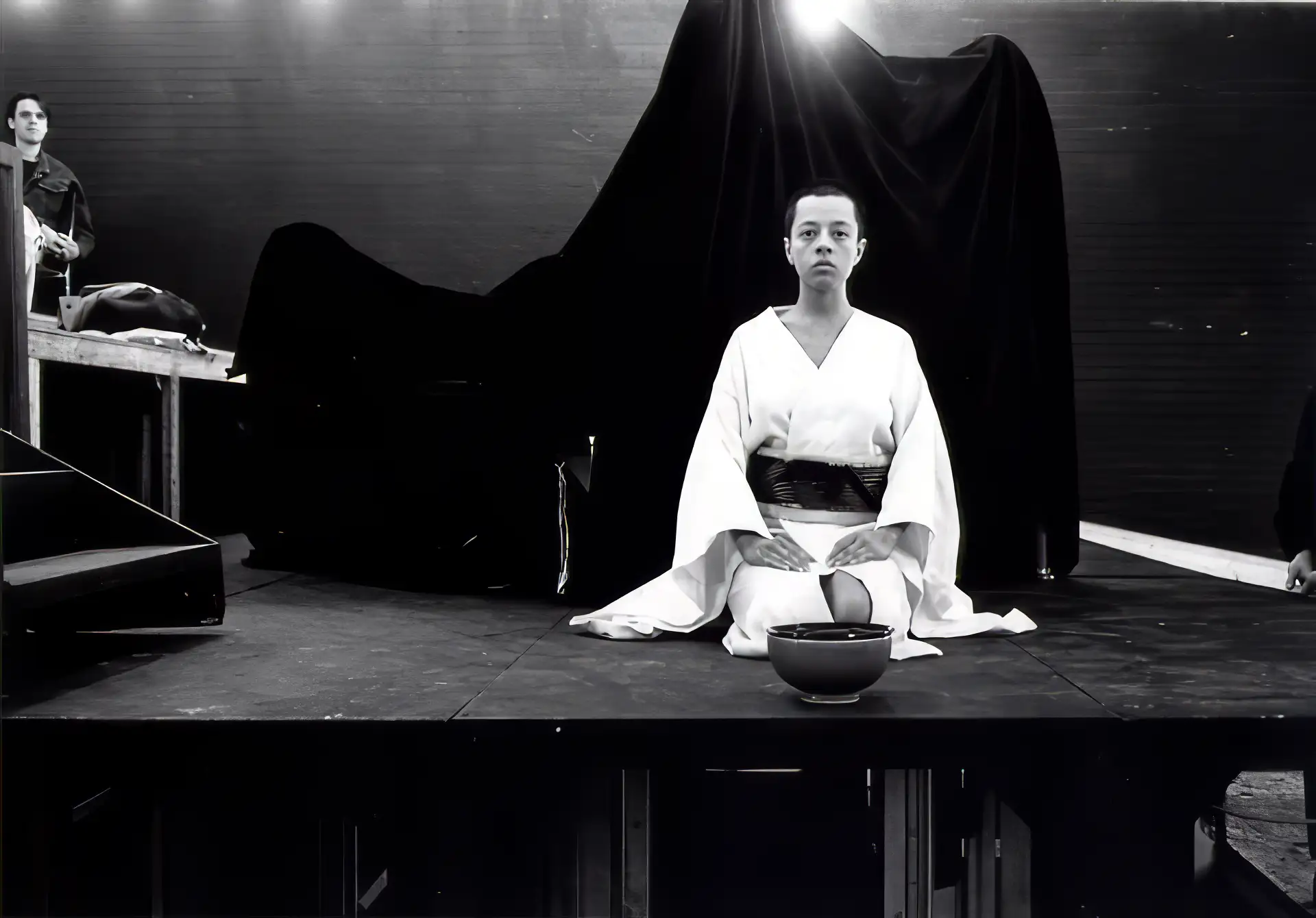
Inside, action erupts randomly. A female samurai warrior (Akascha Kerekes) moves up and down a long ramp. King Claudius (Sky Gilbert) is calmly eating a chicken. Queen Gertrude (Shirley Josephs) sits on a big brass bed, applying makeup.
7:45 p.m. A very bald Hamlet (Andrew Scorer) faces up to his mother and strips off his inky cloak to shed the “trappings and the suits of woe.” We’re still in Act I, Scene II. This doth not bode well.
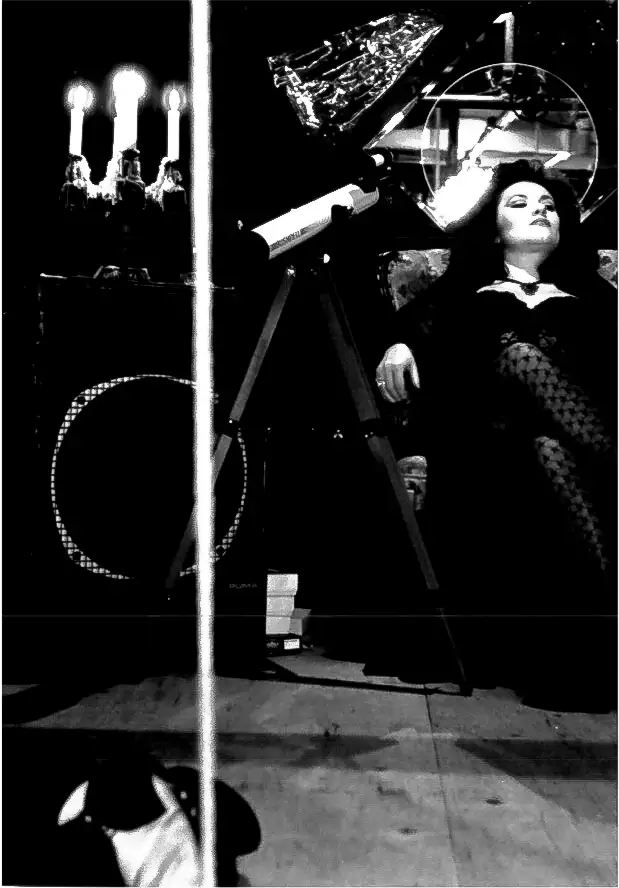
8 p.m. Polonius (Ed Fielding) is clipping his nails before going to bed. But that’s only one point of action in a multi-ringed circus. A Count Dracula stand-in introduces himself as the Explicator (Adrian Foster). He stands by to fill you in on who’s who and what’s what.
9 p.m. The “teacup dance,” a pure digression in which eight actresses form a chorus line and clink cup to saucer to In the Mood. A couple of saucers break, but the dance goes on, and on, and on.
10:25 p.m. German opera singing underscores the play-within-the-play, which proceeds at a snail’s pace. Reporter writes “pretentious horse ... ” in notebook and decides to take a supper break.
11:30 p.m. Welcomed back by Explicator. Reporter is told that Hamlet has left for England; Rosencrantz (Ken McDougall) and Guildenstern (Daniel McIvor) are dead; and Ophelia (Kirsten Johnson) is going mad. Ophelia squashes raw fruit against her chest to prove her point. When Laertes (Scott Maudsley) makes a roaring entrance, columnist Francine Grimaldi, who has been dozing, snaps to attention.
12:25 a.m. Ophelia has drowned and her portrait is hung in remembrance along with those of the other dearly departed. This is a great way to keep score on the death toll in Denmark. Meanwhile, in limbo, a naked Polonius gets whipped by the Mistress of the Underworld (Rosalia Martini). Totally gratuitous but it raises a few drooping eyelids.
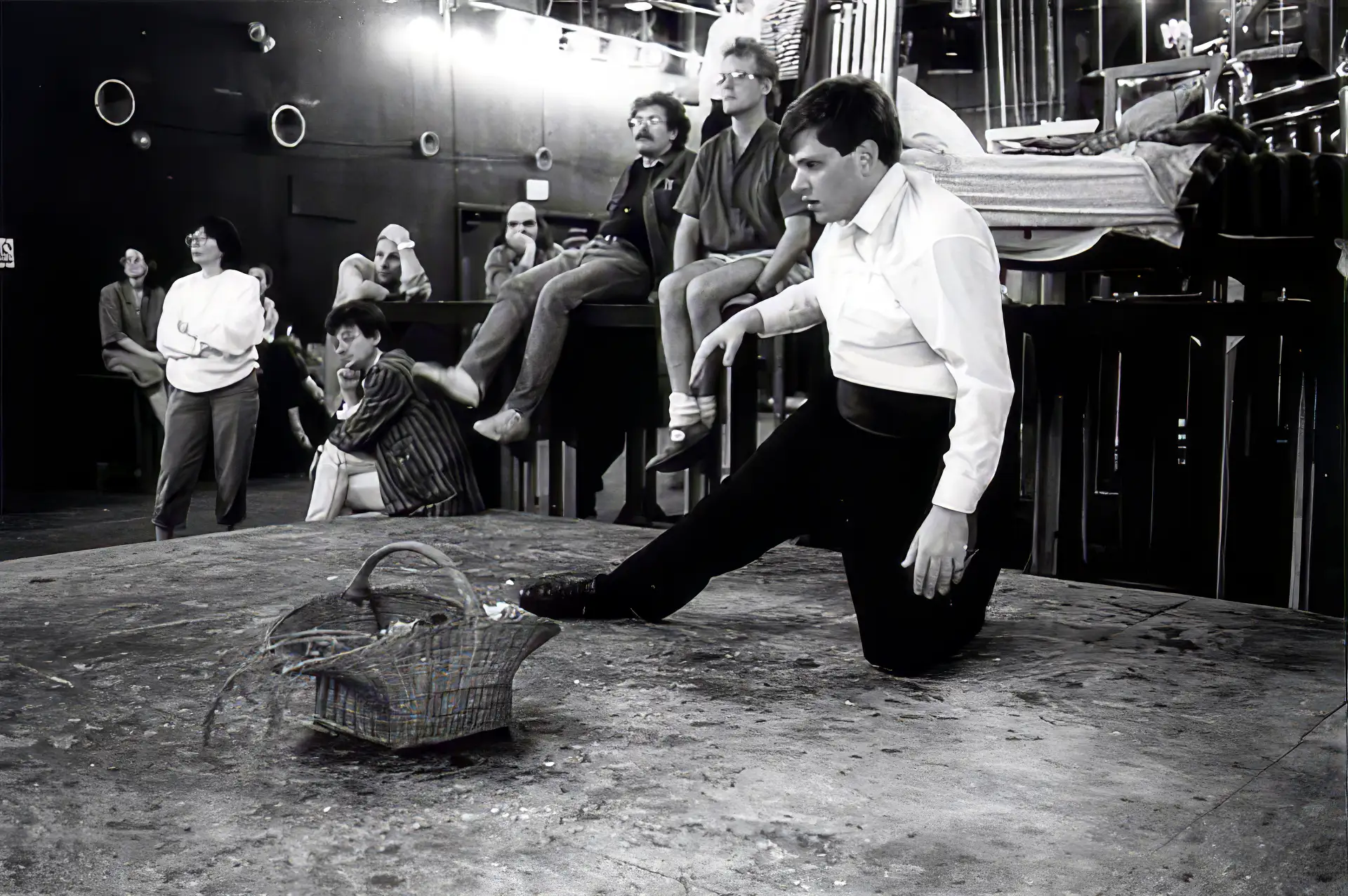
1:30 a.m. Laertes and Hamlet fence. Polaroids are taken and a referee waits for the film to develop before declaring a hit. Hysterically funny, especially when you’re almost hysterical with fatigue anyway.
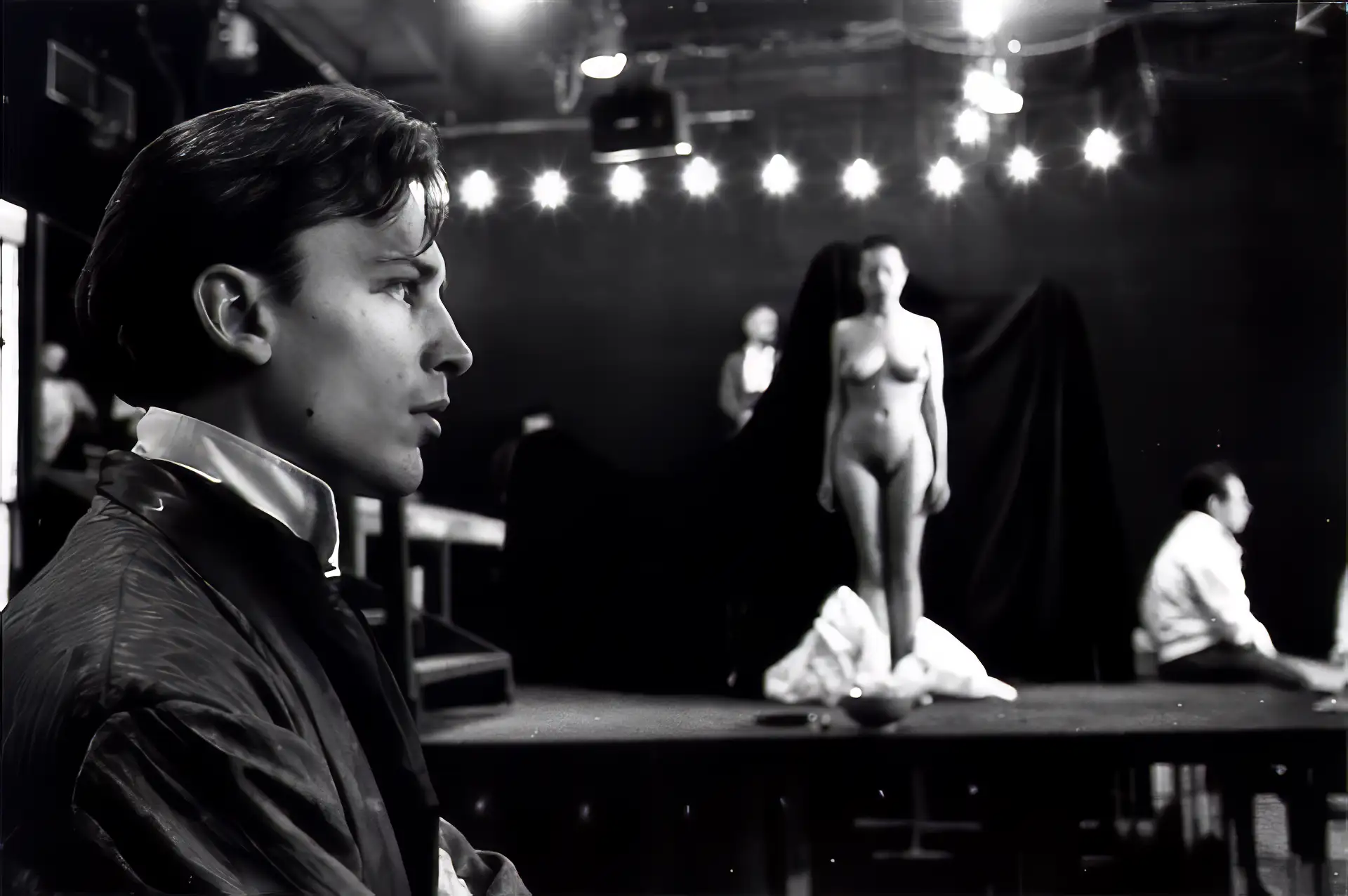
2:30 a.m. Of an audience of 100 spectators, 31 stalwarts remain. At least six are journalists and three – believe it or not – are senior citizens. Gertie, Claudius and the rest of the folks in the Underworld discuss their inner motivations. The samurai – who just spilled a bowl of chicken guts – now stands starkers like Venus de Milo with arms. Over the sound system we hear the strains of Is That All There Is?
2:31 a.m. Assured by a round of applause that the end has come, reporter departs hastily, in mortal fear on an encore.
The Gazette, May 31, 1989
Hamlet, Mad, Mad, Mad…
Crazy, crazy, crazy theatre at Espace Libre. A marathon production lasting over eight hours (according to my watch, I started at 6 p.m. and finished at 2:35 a.m.) and the feeling of having fully experienced theatre, of having chosen my own images, of having been close to the characters, and of having made the cuts myself. DNA Theatre offers an ideal, utopian theatre that assaults, disturbs, or enchants, depending on your perspective. There's no reference point for this kind of theatre except for DNA Theatre's last production, presented at the Festival de théâtre des Amériques in 1987: This is What Happens in Orangeville.
There were around 120 of us at the start of the show. I counted 21 at the very end. Curiously, these were the older members of the audience (excluding journalists), people who were clearly experiencing a great moment of theatre. Others (about forty) had walked out after an hour of the performance.
You either love or hate DNA Theatre; there's no middle ground. From the start, they assault the audience by making them wait at the door for quite some time. They let people in in groups of three or four and then treat them rudely afterwards.
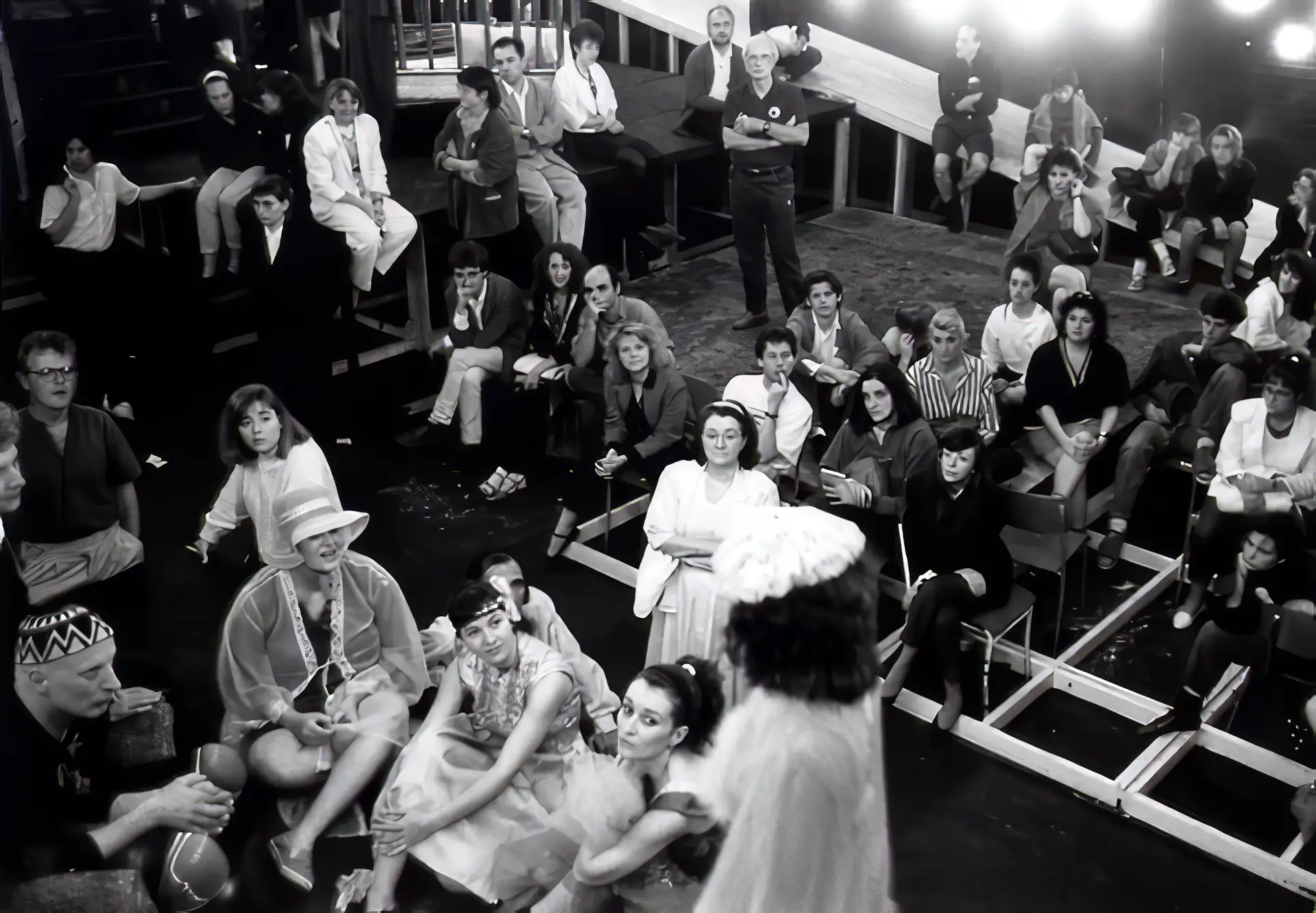
Once you arrive at the theater, you discover the characters scattered throughout the auditorium. The stage design is magnificent, with platforms on different levels. The spectator is constantly in motion, moving from one scene to another as they choose. They become almost voyeurs, eavesdropping on Hamlet's whispers to another character. At times, the music erupts, bursting at ear-splitting volume. We are told not to interfere with the actors' performances, and if, unfortunately, we find ourselves within the performance space, a woman threatens us with a "Move!" that brooks no argument. A truly fascist world designed to instill fear.
The music is intoxicating, the choreography remarkable, and the balance of the performance allows us to experience, for example, the rage, the explosion, the tenderness, and the infinite sadness of Ophelia's death. I had the impression that the priest had sung the entire mass.
It even incorporates music-hall elements, complete with dancers and teacups. While respecting Shakespeare's text, it adds a host of new elements, and the most inspired touch was undoubtedly the Last Judgment, where the characters recount their lives after leaving their bodies. And after eight hours of performance, the show concludes with the song "Is That All There Is," the epitome of cynicism. A must-see, at least once in a lifetime.
La Presse, May 1, 1989
Hamlet fou, fou, fou …
Du théàtre fou, fou, fou à l’Espace Libre. Une production-marathon de plus de huit heures (à ma montre, entrée à 18 h et départ à 2 h 35) et l’impression d’avoir vécu pleinement le théâtre, d’avoir choisi mes propres images, d’avoir côtoyé les personnages et d’avoir effectué moi-même les coupures. Le DNA propose un théâtre idéal, utopique qui agresse, dérange ou enchante, c’est selon. Aucune référence pour ce genre de théâtre si ce n’est la dernière production du DNA Theatre, présentée au Festival de théàtre des Amériques en 87 This is what happens in Orangeville.
Nous étions autour de 120 personnes en début de spectacle. J’en ai compté 21 à la toute fin. Curieusement il s’agissait des spectateurs les plus âgés (si on exclut les journalistes), des gens qui vivaient manifestement un grand moment de théâtre. D’autres (une quarantaine) avaient claqué la porte après une heure de représentation.
On aime ou on n’aime pas le DNA Theatre, il n’y a pas de milieu. Dès le début on agresse le spectateur en le laissant poireauter à la porte pendant un bon moment. On laisse entrer les gens par groupes de trois ou quatre et en les recevant rudement par la suite.
Une fois rendu sur le lieu théàtral on découvre les personnages un peu partout dans la salle. Magnifique construction scénique avec des plateaux à différents niveaux. Le spectateur est continuellement en mouvement : il va d’une scéne à l’autre selon son choix. Il devient carrément voyeur en tendant l’oreille aux propos de Hamlet qui chuchote avec un autre personnage. Parfois la musique éclate à vous défoncer les tympans. On nous informe qu’il ne faut pas intervenir dans le jeu des comédiens et lorsque par malheur on se retrouve à l’intérieur de l’espace de jeu, une femme vient nous menacer avec un « move! » qui n’admet pas de réplique. Un véritable monde faciste qui veut faire peur.
La musique est enivrante, la chorégraphie remarquable et l’équilibre du spectacle nous permet de passer par la rage, l’éclatement, la douceur et l’infinie tristesse de la mort d’Ophélie, par exemple. J’ai eu l’impression que le prètre avait chanté la messe au complet.
On y retrouve même du music-hall avec des danseuses et des tasses de thé. On respecte le texte de Shakespeare en y ajoutant plein de choses et la meilleure trouvaille a sûrement été le jugement dernier alors que les personnages viennent expliquer leur vie après avoir quitté leur corps. Et après huit heures de spectacle, on quitte la scéne avec la chanson Is that all there is, suprème cynisme. À voir, une fois dans sa vie.
La Presse, 1 mai, 1989
Stage Bodies
FESTIVALS: THE ROLE OF RISK
Hillar Liitoja and Toronto's DNA Theatre have been familiar to us since the 1987 FTA when the company presented This is What Happens in Orangeville. This time, the director has chosen Hamlet, less to offer a new "reading" than to move freely within it and literally "play with it"—as one might say of a musical instrument. Liitoja's conception is comprehensive, profoundly postmodern, carrying a mountain of contradictions (which, of course, are also our own), oscillating between respect and disrespect, drawing on the sources (musical, in particular) of Romanticism to the point of exacerbation, and not hesitating to leave gaps, hollowed-out sequences where almost nothing happens—except our own expectation as spectators caught in the middle of an anticlimax. Thus, the main protagonists of this production were the audience (each spectator invited to move around the performance space where several simultaneous actions took place, able to modify their angle of perception at will) and time. Certainly, the duration of the performance itself was imposing – approximately eight hours – but it was through its musicality, which used repetitions, looped reiteration, echoes, and leitmotifs, that temporality, worked as an almost autonomous formal material, manipulated perception, pushing the spectator to experience vertigo before these repetitions that opened like an abyss into which meaning momentarily plunged, metaphorically referring to the feigned/real delirium of Hamlet and his double, the director himself, who orchestrated a veritable theatrical symphony before our eyes. Playing with intensities—the famous "To be or not to be..." monologue almost inaudible, the ostentatious entrances of Claudius and Gertrude, for example—and thwarting the logic of events—by stretching or accelerating the supposedly known action—Liitoja delighted in dissolving the familiar reference points of the famous tragedy, making possible a different kind of listening, a different use of Shakespeare's text. The spectator could thus accompany, in the strictest sense, one or the other of the characters, in their wandering, in their singular blindness, in their devastating passion—which soon left only corpses that, one by one, had taken refuge in a grotesque Kingdom of the Dead—a kind of brothel guarded by an enterprising Madame—which was situated above all the other stage areas and was the only place absolutely forbidden to the spectators. With this production, Liitoja shifted to the spectator himself the subjectivity that the modern artist had already seized upon at the turn of the century; it was not, thank God, a question of participation, but of freedom: the spectator discovered himself to be free and it was up to him to compose his trajectory within the "performance" and to live as he pleased, even with absences, his experience of Hamlet, through the original and open vision offered by the DNA.
Parachute #56, Oct-Dec 1989
Corps scéniques
FESTIVALS : LA PART DU RISQUE
L’expérimentation de Hillar Liitoja et du DNA Theatre de Toronto nous est connue depuis le FTA 1987 alors que la compagnie avait présenté This is What Happens in Orangeville. Cette fois, le metteur en scène a choisi Hamlet, moins pour en proposer une nouvelle "lecture" que pour s’y déplacer librement et littéralement "en jouer" - comme on le dit d’un instrument de musique. La conception de Liitoja est globale, profondément postmoderne, charriant une montagne de contradictions (qui, bien sûr, sont aussi les nôtres), oscillant entre le respect et l’irrespect, puisant aux sources (musicales, notamment) du romantisme jusqu’à l’exacerbation et n’hésitant pas à laisser des trous, des séquences évidées où il ne se passe presque rien - sinon notre propre attente de spectateur saisi en plein anti-climax. Aussi, les principaux protagonistes de cette réalisation étaient le public (chaque spectateur invité à se déplacer dans l’espace de jeu où plusieurs actions simultanées ont cours, pouvant modifier à sa guise son angle de perception) et le temps. Certes, la durée en elle-même de la représentation en imposait - environ huit heures -, mais c’était par sa musicalité, laquelle usait de reprises, de la réitération en bouclè, d’échos et de leitmotive, que la temporalité, travaillée comme matériau formel quasi autonome, manipulait la perception, poussait le spectateur à éprouver le vertige devant ces répétitions qui ouvraient comme un abîme dans lequel s’engouffrait momentanément le sens, renvoyant métaphoriquement au délire feint/réel d’Hamlet et de son double, le metteur en scène en personne qui orchestrait à vue une véritable symphonie théàtrale. Jouant des intensités – le fameux monologue "To be or not to be..." presque inaudible, les entrées ostentatoires de Claudius et Gertrude, par exemple -, déjouant la logique événementielle – en étirant ou en accélérant l’action présupposée connue -, Liitoja se plaisait à dissoudre les points de repère familiers de la célèbre tragédie, à faire en sorte qu’une autre écoute, un usage autre du texte shakespearien puisse être possible. Le spectateur pouvait ainsi accompagner, au sens strict, l’un ou l’autre des personnages dans leur errance, dans leur aveuglement singulier, dans leur passion dévastatrice – ce qui ne laissait plus bientôt que des cadavres qui, un à un, s’étaient réfugiés dans un grotesque Royaume des morts – sorte de maison close gardée par une Madame entreprenante – qui était placé en surplomb par rapport à l’ensemble des lieux scéniques et qui était le seul endroit absolument interdit d’accès aux spectateurs. Avec cette production, Liitoja déplaçait vers le spectateur lui-même la subjectivité dont s’était déjà emparé, au tournant du siècle, l’artiste moderne; il ne s’agissait pas, Dieu merci, de participation, mais de liberté: le spectateur se découvrait libre et il lui appartenait de composer sa trajectoire dans la "représentation" et de vivre à sa guise, même avec des absences, son expérience d’Hamlet, à travers la vision originale et ouverte, qu’en proposait le DNA.
Parachute #56, Oct-dec 1989
Guestbooks
After every performance, the audience exits into a space where Guestbooks are laid out. Some write in them; some don’t. Some send emails which are then taped into the books.
- Dear DNA – Will I be able to live without you? The endless hours of doing nothing with DNA will now have to go on … I did not enjoy every single moment, for every moment held some new and repulsive fact of life to be embraced with much caution. A loathsome task indeed. It was my pleasure.
- Never in my life have I gone through such a constant barrage of intertwined bullshit and eloquence. I thought the ending, in which everyone is dying or dead, to be the utmost in contrived offence. I have no doubt that is exactly what you intended. You succeeded in this with the utmost of nauseating ease. My congratulations.
- Boring boring boring – and old – thanks.
- (cf. Performing garage 1970) - Trop bien.
- Well, another outstanding performance to your credit. The text revealed in such unusual form, and in so many different ways, brings life to the acting. I find my mind wanders from the action, desperate for further stimulation. When there is not silence, there is music. Ear-splitting volume and superb pieces combine to touch the care of my body, of my soul.
- Merci beaucoup. C'était fabuleux. Un privilège d'assister à un si beau spectacle.
- Lovely: I enjoyed almost every minute of your performance. The mélange of noise; music, voice, and every extraneous sound know to man, was dazzling, stupefying, astounding! Every action piqued my senses in a new way. Amen.
- Je ne sais pas dans quelle catégorie vous placer … mais … excellent et merci.
- (Henri Pardo) - I loved the show. I didn't understand it completely, but it loved it anyways. The choreography [repeated for the fourth time in a row] was … kind of annoying.
- Ma deuxièmes experiénces fût encore meilleurs … Bravo
- They told me Shakespeare was boring … They told me theatre was dead. They told me so many things that weren't true. Thank you. I'm not sure for what. There must be a god.
- (Sophie) - Heureuse pour vous, heureuse pour moi. Une âme dans ta maison pendant longtemps.
- (Elyse) - It is interesting to witness this closest to living tragedy of Hamlet, before this piece, we could categorize Hamlet; now you have dethroned it and made a rebirth of a brilliant masterpiece for everyone to see again and learn with interest …
- Eight hours is not long in your company. I enjoyed each moment of it.
- J'ai aimé … quelle performance de concentration marathonienne.
- “Who could ask for anything more?”
- (Solange Lévesque) - Rester ou ne pas rester jusqu'á la fin. C'est une grande question!!
- (Catherine Alarie) Avec toute mon admiration.